
Why a Geothermal Heat Pump Install Is Worth Understanding Before You Commit
If you’ve ever had no heat in the house during a Glenview, IL cold snap or noticed your energy bill went up HVAC after a brutal winter, you’ve probably looked into alternatives that can keep your home comfortable without constant surprises.
A geothermal heat pump install is one of the biggest home comfort decisions a Chicagoland homeowner can make — and one of the most misunderstood.
Here’s the quick overview if you’re in research mode:
- What it is: A system that moves heat between your home and the ground using buried piping and an indoor heat pump
- How much it can help: Many homeowners see meaningfully lower heating and cooling energy use compared to traditional setups
- Key incentive: A 30% federal tax credit may apply to the installation (talk with your tax professional for your situation)
- How long it lasts: The indoor unit often lasts 20+ years; ground loops can last 50 years or more
- Installation time: Many residential projects are completed in about 2 to 4 weeks
The core idea behind geothermal is simple. Just a few feet below the surface, ground temperature stays remarkably stable year-round — typically around 55°F here in the Midwest. That stability is what makes geothermal systems so efficient, even during a harsh North Shore winter or a sweltering August heat wave.
Unlike a furnace that burns fuel or an air-source heat pump that works harder when temps drop below freezing, a geothermal system draws on a steadier temperature source underground. That’s why these systems are often rated at significantly higher efficiency levels compared to air-source alternatives.
This guide breaks down everything: how the technology works, which loop type fits your property, what installation actually involves, and how to evaluate whether it’s the right long-term investment for your home.
How Geothermal Technology Utilizes Earth’s Energy
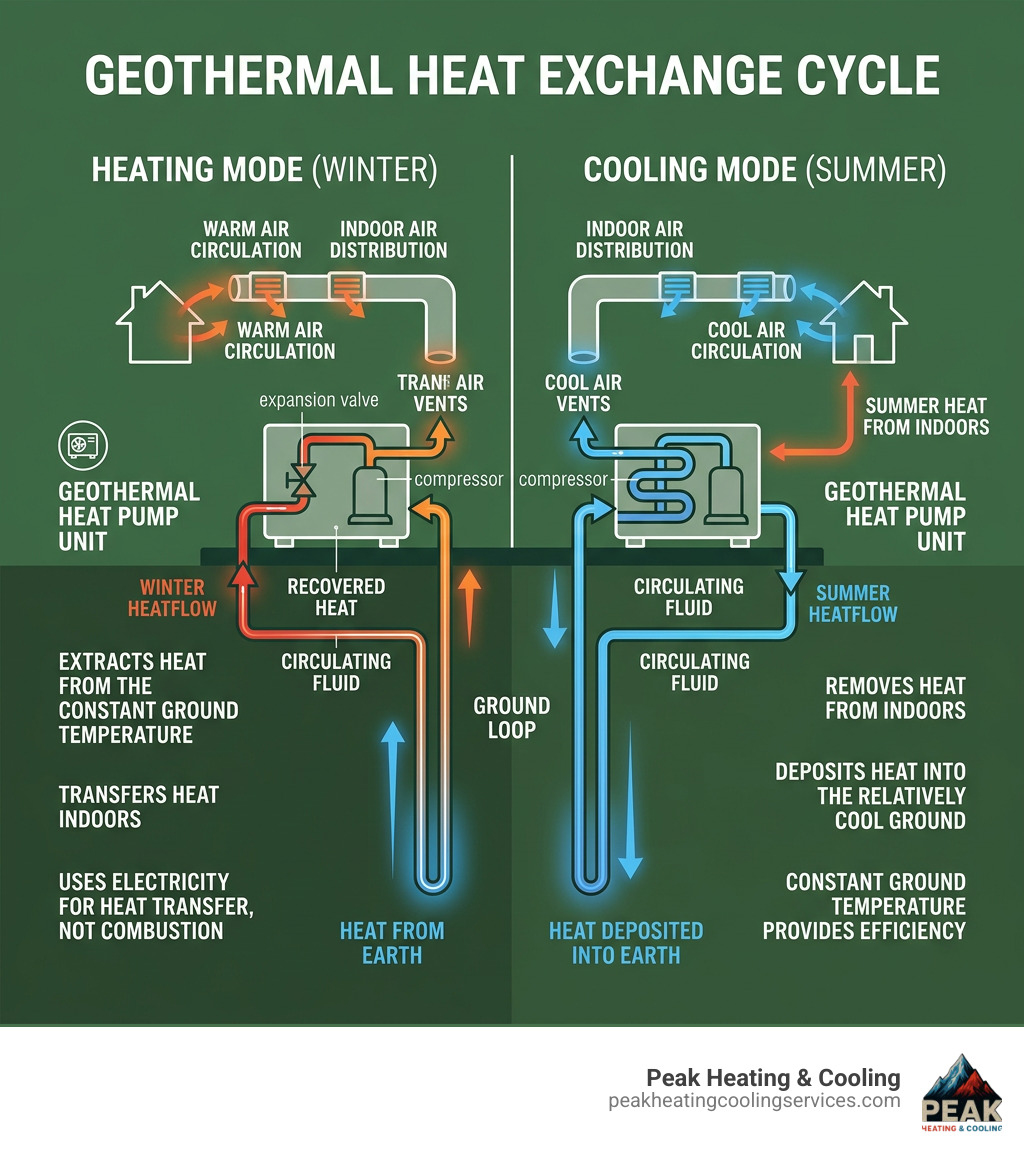
At its heart, a geothermal system is a heat transporter. It doesn’t “create” heat through combustion like a traditional gas furnace; instead, it moves existing thermal energy from one place to another. During a cold Northbrook winter, the system extracts heat from the earth and brings it into your home. In the summer, the process reverses: the system pulls heat out of your house and deposits it back into the relatively cooler ground.
The reason it works so well in Chicagoland is that the earth acts like a massive thermal storage battery. While our air temperatures can swing from well below freezing to peak summer heat, the temperature a few feet below the frost line stays far more consistent. This stable environment serves as a “heat source” in winter and a “heat sink” in summer. Research commonly cites that this process can 30 to 70 percent reduce annual heating and cooling energy use in the right home.
As a locally operated, licensed and insured HVAC contractor serving Glenview, IL and the North Shore for 20+ years, we’ve seen how that stability can translate into more even comfort (fewer hot/cold spots) compared to many conventional systems. If you’re comparing options like heat pump installation Chicagoland homeowners are choosing more often, geothermal is worth understanding before you commit.
Core System Components
To understand a geothermal heat pump install, you have to look at the three main parts working in tandem:
- The Ground Heat Exchanger: This is the “loop” — a series of high-density polyethylene pipes buried in the earth.
- The Refrigerant Loop: Located inside the heat pump unit, this transfers the heat between the ground loop and your home’s air.
- The Air Handling System: This distributes the conditioned air through your ductwork.
Performance in Cold Climates
A common question we hear in places like Skokie and Wilmette is: “Can geothermal really handle an Illinois winter?” In most properly designed systems, yes. Because the system relies on the steady underground temperature rather than the freezing outside air, it can maintain capacity more consistently through cold weather. Even when there’s snow on the ground, the fluid in the buried loops can still absorb usable heat from the soil.
Choosing the Right Loop for Your Geothermal Heat Pump Install
Every property in the North Shore and Northwest Suburbs is different. A sprawling lot in Barrington might have space for a horizontal loop, while a compact yard in Park Ridge might require vertical drilling. Selecting the right configuration is the most critical part of the design phase.
Preparing Your Property for a Geothermal Heat Pump Install
Before any digging begins, we perform a comprehensive site evaluation. This includes a Manual J calculation to determine exactly how much heating and cooling your specific home requires. We also look at:
- Soil Composition: Different soils transfer heat at different rates (thermal conductivity).
- Land Availability: We measure the square footage available for the “loop field.”
- Utility Line Location: We must identify all existing gas, water, and electric lines to ensure a safe installation.
Our Heating Contractor Services ensure that the system is sized perfectly for your home’s thermal load, preventing the common industry pitfall of “oversizing” which leads to poor dehumidification and equipment wear.
Loop Configuration Options
Depending on your property, we may suggest one of the following:
- Vertical Boreholes: Ideal for smaller lots. We drill holes 150 to 400 feet deep and insert U-shaped pipes. This is the most common choice for residential retrofits in Glenview and Northbrook.
- Horizontal Loops: If you have a larger yard, we can dig trenches about 6 feet deep. We often use “slinky coils” — overlapped loops of pipe — to maximize the heat exchange surface area in a smaller trench.
- Pond/Lake Loops: If your property has a sufficiently deep body of water, we can submerge the pipe loops at the bottom, which is often a very cost-effective method.
- Open Loop Systems: These use well water directly for heat exchange before discharging it. However, these require a steady supply of clean water and specific local permits.
Comparing Geothermal Efficiency to Air-Source Systems
While we provide expert Air Conditioning Repair Service for all types of systems, geothermal stands in a league of its own regarding efficiency.
| Feature | Geothermal Heat Pump | Air-Source Heat Pump |
|---|---|---|
| Efficiency | Significantly Higher | Standard |
| Source of Energy | Stable Ground Temp (~55°F) | Fluctuating Air Temp |
| Indoor Unit Lifespan | 20 – 25 Years | 10 – 15 Years |
| Ground Loop Lifespan | 50+ Years | N/A |
| Maintenance Need | Very Low | Moderate |
System Longevity and Durability
One of the strongest arguments for a geothermal heat pump install is how long the infrastructure lasts. According to the Department of Energy, the underground loops are virtually permanent, often lasting up to 50 years or more. The indoor heat pump unit is protected from the elements (unlike an outdoor AC condenser), allowing it to reliably serve your home for 25 years. For many North Shore homeowners, this is a “once-in-a-generation” investment that can significantly boost home value.
Operational Noise and Comfort
Because there is no heavy outdoor compressor fan kicking on and off, geothermal systems are incredibly quiet. They also provide superior humidity control. By using variable-speed fans, the system provides a steady, gentle flow of air that eliminates the “hot and cold spots” often felt with traditional furnaces.
The Step-by-Step Installation and Integration Process
Installing a geothermal system is more involved than a simple furnace swap, but our team makes the process seamless. Our Services cover every phase from the first shovel in the ground to the final thermostat calibration.
Professional Standards for a Geothermal Heat Pump Install
We adhere to the highest industry standards, including IGSHPA (International Ground Source Heat Pump Association) guidelines. A typical installation follows this path:
- Drilling/Trenching: We install the loops and backfill with thermal grout to ensure maximum heat transfer.
- Indoor Placement: We install the heat pump unit, usually in a basement or utility room.
- Flushing and Testing: We flush the loops to remove air and debris, then pressure-test the entire system to ensure it’s leak-free.
- Commissioning: We charge the system with refrigerant and verify that the flow rates and temperatures meet design specifications.
Integration with Existing Infrastructure
If you are retrofitting an older home in Winnetka or Glencoe, we start with a thorough ductwork inspection. Geothermal requires specific airflow volumes to operate efficiently. We can also integrate these systems with radiant floor heating or smart thermostats (like Nest or Ecobee) to give you total control over your home’s climate and energy usage.
Long-Term Financial Value and Incentives
While the upfront investment for a geothermal heat pump install is typically higher than a standard HVAC swap, many homeowners consider it for long-term stability, comfort, and reduced energy use. We offer 0% financing options for qualified customers to help make an installation or replacement project more manageable. You can find more info about HVAC financing on our website.
Estimating Your Energy Savings
Many homeowners report meaningful reductions in heating and cooling energy use after switching to geothermal, especially when replacing older equipment and when the home has solid insulation and ductwork. Actual results depend on system design, loop type, and how your home is used.
Available Financial Support
One of the biggest incentives homeowners ask about is the 30% federal geothermal tax credit, which may apply to eligible geothermal installations, including equipment and labor. Eligibility and filing details can vary, so it’s smart to confirm requirements with a tax professional.
If you’re considering a geothermal upgrade in Glenview or nearby communities like Northbrook, Wilmette, or Park Ridge, the combination of long-term efficiency and available incentives can make the decision easier to evaluate. Contact Peak Heating & Cooling to discuss your options.
Maintenance and Professional Service Requirements
Geothermal systems are low-maintenance, but they aren’t “no-maintenance.” To protect your warranty and keep performance consistent, we recommend routine professional servicing.
Our Furnace Repair Services and maintenance plans include:
- Checking loop pressure and antifreeze levels.
- Replacing high-efficiency air filters.
- Inspecting the condensate drain and electrical connections.
- Cleaning the heat exchanger coils.
Risks of DIY Installation
We occasionally hear about homeowners attempting a DIY geothermal project. We strongly advise against it. Geothermal requires accurate load calculations, proper loop field design, and specialized tools for correctly joining underground piping. A poorly designed system can lead to comfort issues (like a house that won’t warm up evenly), higher energy use, and equipment wear.
Choosing a Qualified Local Contractor
When investing in geothermal, you want a partner who knows local conditions and local building requirements. Peak Heating & Cooling is a family-owned, locally operated company serving Glenview, IL and surrounding North Shore and Northwest Suburbs communities. We’re licensed and insured, and we focus on clear communication and doing the job the right way.
If you’re ready to explore options or you need help quickly because your furnace stopped working suddenly or your system keeps cycling on and off, Contact Us for same-day service when available.
Frequently Asked Questions about Geothermal Installation
How long does a typical geothermal heat pump install take?
While every home is different, the average residential project takes between 2 and 4 weeks. The outdoor loop installation usually takes 3 to 5 days, while the indoor equipment swap and integration take another 2 to 3 days.
What happens to my landscaping after the ground loops are installed?
There will be some disruption to your yard during the drilling or trenching phase. However, once the pipes are buried and the soil is replaced, your lawn typically recovers within one growing season. For vertical installations, the “footprint” of the work is quite small, often requiring only a few 4-inch holes.
Conclusion
A geothermal heat pump install is more than just a new HVAC system; it’s a commitment to sustainable comfort and long-term energy stability. By tapping into the stable energy right beneath your feet, you can reduce your dependence on fluctuating fuel markets while enjoying the quietest, most consistent heating and cooling available today.
At Peak Heating & Cooling, we are proud to be the trusted Glenview, IL experts in this technology. As a family-owned, locally operated company with 20+ years of experience, we’re licensed and insured and committed to doing the job the right way. Whether you need a new installation, a system replacement, or 24/7 emergency service, our team is here to help with same-day repairs and expert advice.
Schedule your geothermal consultation today and discover what a geothermal system could mean for your Chicagoland home.