

714 Glenwood Ln, Glenview, IL
peakheatingcooling1@gmail.com
(773) 860-0451



In Glenview, your HVAC system might be working perfectly — and you’d still be uncomfortable. Leaky ducts push conditioned air into attics, wall cavities, and crawl spaces before it ever reaches the rooms you’re trying to heat or cool. You pay to condition that air. You just never feel it.
Peak Heating & Cooling provides duct repair and sealing in Glenview and across Chicagoland. Our licensed technicians locate leaks, seal joints properly, and restore airflow to every room in your home. We offer free estimates, same-day scheduling, and honest assessments of whether sealing or replacement is the right call for your system.
This page covers duct leak diagnosis, professional sealing, ductwork repair, and replacement assessment. If your home has rooms that never reach the right temperature, energy bills that keep climbing, or dust that settles faster than it should — your ducts are a likely cause.
Most homeowners never think about their ductwork. It’s hidden in the attic, tucked in the walls, or running through the crawl space. Out of sight, out of mind — until the energy bills climb and certain rooms stop behaving the way they should.
Leaky ducts are one of the most common and least-diagnosed sources of home comfort problems in Glenview. According to the U.S. Department of Energy, the average home loses 20–30% of conditioned air through duct leaks before it reaches living spaces. In older Glenview homes with attic ductwork running through unconditioned spaces, that number can be higher.
Here’s what that looks like in practice:
A system that wears out faster. When ducts leak, your HVAC equipment compensates by running longer cycles. More runtime means more wear on the blower motor, heat exchanger, compressor, and every other component in the system. Duct leaks don’t just cost you on energy bills — they shorten the life of equipment you’ve invested thousands of dollars in.
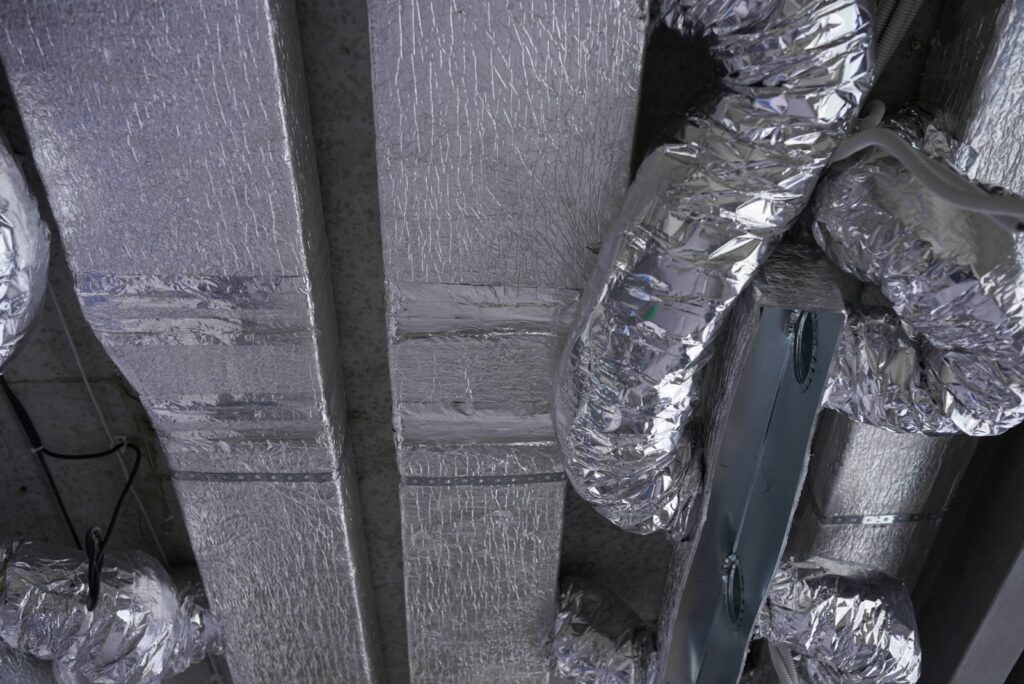

When homeowners ask how long duct sealing lasts, the honest answer is: it depends on how it was done.
Professional mastic sealing — applied correctly to clean, dry duct surfaces — typically lasts 10–15 years or more. In some cases, a well-sealed duct system stays sealed for the life of the equipment. The material bonds chemically to the duct surface and remains flexible through temperature changes without cracking or peeling.
DIY duct tape products are a different story. Standard duct tape — including many products marketed specifically for ducts — uses a pressure-sensitive adhesive that degrades under heat cycling. In Glenview’s climate, where attic temperatures swing from sub-zero in January to 130°F+ in July, that adhesive breaks down fast. Most DIY tape sealing starts failing within one to three seasons.
Material used. Mastic sealant outlasts tape in virtually every application. Where tape is used by professionals, it’s metal-backed HVAC-rated tape — not hardware store products.
Surface preparation. Mastic applied to dusty, damp, or deteriorated duct surfaces won’t bond properly. Professional application includes surface prep before sealing begins.
Duct condition at the time of sealing. Sealing a duct that’s already structurally compromised buys time — it doesn’t solve the underlying problem. If the duct material itself is deteriorating, sealing extends its life but doesn’t replace the need for eventual replacement.
Temperature cycling intensity. Glenview’s extreme seasonal swings put more stress on sealed joints than moderate climates do. This is one reason professional-grade materials matter here more than they would in, say, Atlanta or Phoenix.
Homes in The Glen and newer Glenview developments have younger duct systems that are good candidates for sealing with a long expected lifespan. Older homes in established neighborhoods may be working with original ductwork where the sealing lifespan depends heavily on what’s underneath.
Not every duct problem is a sealing problem. And not every aging duct system needs to be replaced. The right call depends on the condition of the ductwork itself — and that requires an honest inspection, not a default recommendation.
Many Glenview homes don’t need a full duct replacement. They need specific problem sections replaced and the rest properly sealed. This approach addresses the worst issues without the cost and disruption of a complete duct overhaul. We identify which sections fall into each category and give you a clear recommendation before any work begins.
Many Glenview homes built between 1960 and 1990 have never had their ductwork assessed. The original installation was done to the standards of its era — which means minimal sealing, undersized returns, and flex duct that has been compressing and expanding through Midwest temperature cycles for decades. An inspection is the only way to know what you’re actually working with.

(773) 860-0451
There’s a big difference between professional duct sealing and someone running a roll of silver tape over visible joints. The tape jobs fail — sometimes within a season. Professional sealing is a diagnostic process that finds leaks you can’t see and fixes them in a way that holds.
Here’s how Peak Heating & Cooling approaches duct repair and sealing in Glenview homes.
Ductwork doesn’t fail dramatically. It deteriorates slowly — losing a little efficiency each year, leaking a little more air each season, degrading air quality in ways that are easy to attribute to other causes. By the time the symptoms are obvious, the problem has usually been building for years.
Here’s the progression that plays out in Glenview homes when ductwork goes uninspected for too long.

There’s a big difference between professional duct sealing and someone running a roll of silver tape over visible joints. The tape jobs fail — sometimes within a season. Professional sealing is a diagnostic process that finds leaks you can’t see and fixes them in a way that holds.
Here’s how Peak Heating & Cooling approaches duct repair and sealing in Glenview homes.

Contact Us

Ready to schedule HVAC maintenance in Glenview? We serve Glenview and the surrounding Chicagoland area with flexible scheduling, same-day availability, and honest service on every visit.
FAQ's
Most residential duct sealing jobs complete in a single visit. A straightforward sealing of accessible joints and connections in an average Glenview home typically takes two to four hours. Larger homes, homes with extensive ductwork in difficult-to-access spaces, or systems requiring partial replacement may require a follow-up visit. We give you a realistic timeline during the free estimate.
Professional mastic sealant applied correctly to clean duct surfaces typically lasts 10–15 years or more. Glenview’s extreme temperature cycling — attic spaces that swing from sub-zero in January to over 130°F in July — is hard on inferior materials, which is why professional-grade mastic and metal-backed HVAC tape outperform DIY products by a wide margin. Hardware store duct tape starts failing within one to three seasons in this climate.
Sealing is the right call when ducts are structurally intact and leakage is occurring at joints and connections. Replacement makes more sense when sections have collapsed, the duct liner has deteriorated, or the system was incorrectly sized or routed. Many Glenview homes need a combination — targeted replacement of problem sections with professional sealing of the rest. We tell you which applies to your system after inspection.
Every five to seven years is a reasonable baseline for homes with functioning systems and no obvious comfort problems. Sooner if you notice rising energy bills, uneven temperatures, increased dust, or worsening allergy symptoms. Homes that have never had a duct inspection — common in Glenview’s older neighborhoods — should schedule one regardless of how the system appears to be performing.
Skipping inspection allows leaks, deterioration, and buildup to worsen silently over years. The consequences include rising energy bills, shortened equipment life, uneven comfort, and declining indoor air quality. There’s no visible symptom that tells you ducts need attention until the problem is significant — which is exactly why periodic inspection matters.
The most common indicators are rooms that are consistently harder to heat or cool than the rest of the house, energy bills that have climbed without a clear cause, dust that accumulates faster than it used to near supply vents, whistling or rushing sounds from the duct system during operation, and allergy symptoms that are worse indoors than outside. Any one of these warrants a duct inspection. Multiple symptoms together make the case clearly.