Why AC Financing Options Matter for Chicagoland Homeowners
AC financing options let you replace or upgrade your cooling system without paying the full amount upfront — spreading the cost into manageable monthly payments instead.
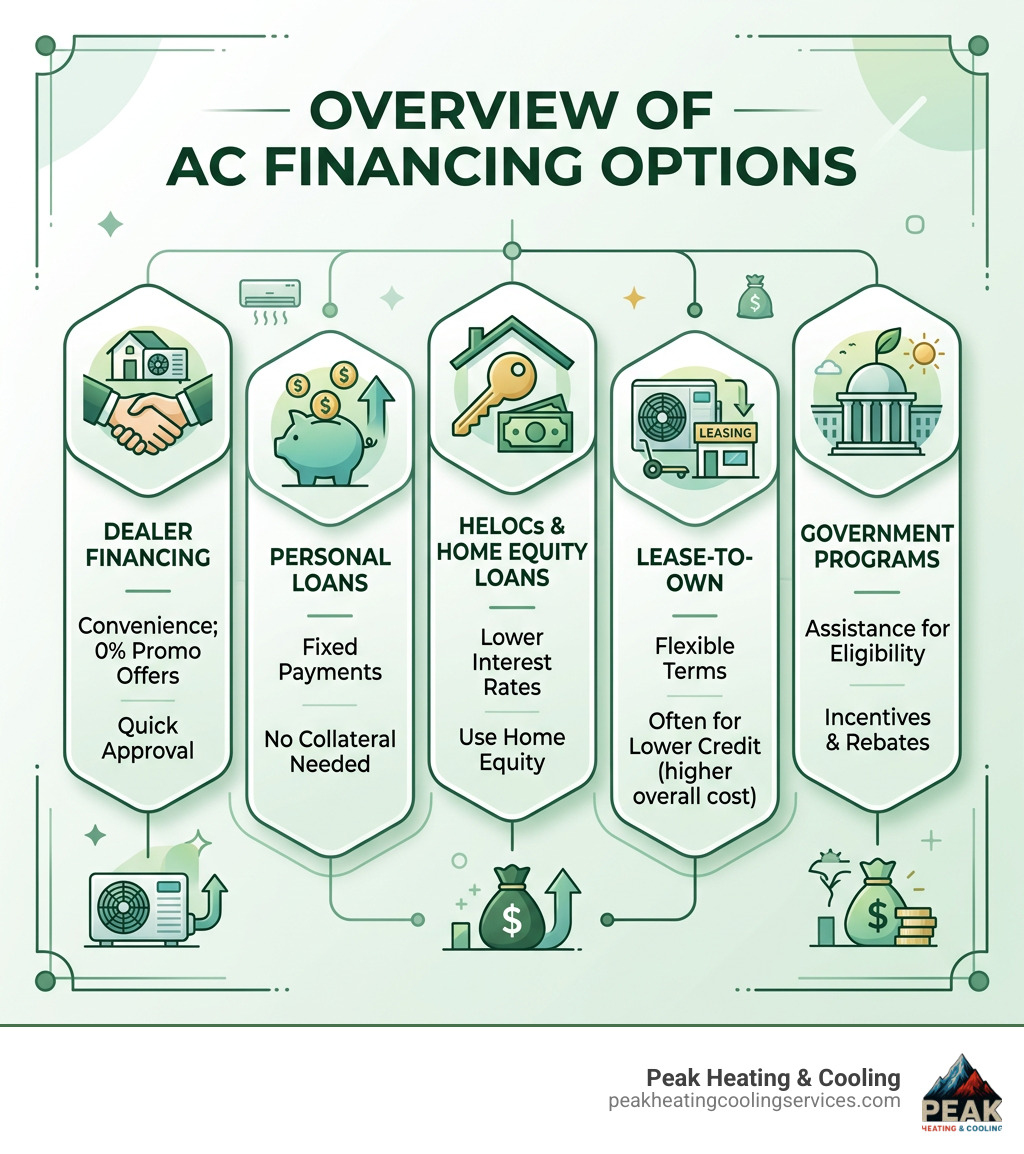
Here are the main ways to finance a new AC unit:
| Financing Option | Best For | Typical APR |
|---|---|---|
| Dealer/contractor financing | Convenience; 0% promo offers | 0% – 28.99% |
| Personal loan | Fixed payments; no collateral needed | 6% – 36% |
| Home equity loan / HELOC | Lower rates; large systems | 6.5% – 11.6% |
| Credit card (0% intro APR) | Smaller jobs; short payoff timeline | 0% intro, then ~21% |
| Lease-to-own / rent-to-own | Bad credit or no credit | Higher overall cost |
| Government programs | Low-income households | Varies |
A new AC system in the Chicagoland area typically runs anywhere from $5,000 to $12,000 or more — and most homeowners don’t have that sitting in a checking account, especially when the breakdown happens on the hottest week of a Glenview summer.
That’s the real-world situation. Your old unit gives out. You’re sweating. And you need a solution now — not in three months after you’ve saved up.
The good news? There are more financing paths available today than most homeowners realize. Some require strong credit. Others work even if your credit history is thin or bumpy. Some come with 0% interest for up to 60 months. Others let you build equity through your home.
This guide walks you through every major option — clearly and without the jargon — so you can pick the one that actually fits your budget and situation.
Understanding Your Main AC Financing Options

When your central air conditioning stops working suddenly, the first instinct is often panic. But before you drain your emergency fund, it is vital to understand the landscape of ac financing options. Financing is generally categorized into two buckets: unsecured and secured.
Unsecured options, like personal loans or credit cards, don’t require you to put up your home as collateral. They are based primarily on your creditworthiness. Secured options, like a home equity loan, use your property to back the debt, often resulting in lower interest rates but higher risk if you can’t make payments.
Before applying for any of these, we always recommend you Check your credit at AnnualCreditReport.com. Knowing your score helps you narrow down which lenders will likely approve your application and what interest rates you should expect.
Exploring Traditional AC Financing Options
For many in the North Shore area, a personal loan is the go-to choice. These are unsecured loans where you receive a lump sum and pay it back in fixed installments over a set period, usually two to seven years.
What is a personal loan? Essentially, it’s a way to get the cash you need for an AC replacement without jumping through the hoops of a home appraisal. Repayment terms are predictable, which makes budgeting easier. For an excellent-credit borrower, a $7,000 loan with a two-year term at an 11.10% APR would mean monthly payments of about $327.
Solutions for Bad Credit or No Credit History
We believe everyone deserves a cool home, regardless of their past credit mistakes. If traditional banks say “no,” lease-to-own programs through providers like Microf might be the answer.
These are structured as rental agreements rather than traditional loans. They often offer instant approvals up to $12,000 with no credit needed. While the total cost over time is higher than a standard loan, these programs provide a vital lifeline for homeowners with bad credit. Plus, making consistent, on-time payments through these specialized ac financing options can actually help you rebuild your credit history over time.
Comparing Personal Loans and Home Equity for HVAC Upgrades
If you have lived in your home in Northbrook or Park Ridge for several years, you likely have built up significant equity. This opens the door to secured financing.
| Feature | Personal Loan | HELOC / Home Equity Loan |
|---|---|---|
| Collateral | None (Unsecured) | Your Home (Secured) |
| Interest Rates | Higher (6% – 36%) | Lower (6.5% – 11.6%) |
| Approval Speed | Fast (1–3 days) | Slow (Weeks) |
| Tax Benefits | None | Potential interest deduction |
What is a home equity loan? It is a loan that uses your home as collateral. Lenders will look closely at your debt-to-income ratio and typically require at least 15% equity in the property to qualify.
Utilizing Home Equity Lines of Credit (HELOC)
A HELOC works like a revolving credit card backed by your home. You get a “draw period” (often 10 years) where you can take out money as needed for your HVAC project and pay it back with variable interest rates.
One major perk is the deduction of home equity interest on your federal taxes if the funds are used specifically to “buy, build, or substantially improve” the home that secures the loan. For a major system overhaul involving new ductwork and a high-efficiency unit, the long-term repayment window of a HELOC can make the monthly cost very manageable.
The Benefits of Dealer and Manufacturer Financing
Many homeowners find that the most convenient ac financing options come directly from the source. At Peak Heating & Cooling, we partner with major lenders to offer specialized terms that banks often can’t match.
Promotional offers like 0% APR for 12 to 60 months are common. These are typically handled through third-party providers like Synchrony Bank or Wells Fargo. You can often Log In to manage your account or check your balance 24/7. However, be wary of “deferred interest” catches. If you don’t pay off the full balance before the promo period ends, you could be hit with back-dated interest at rates as high as 28.99%.
Navigating Manufacturer-Backed AC Financing Options
We often recommend Lennox and Ducane systems because these manufacturers provide robust support for homeowners. They frequently offer dedicated credit limits specifically for home improvement.
You can often Begin Here to see if you prequalify without any impact on your credit score. The biggest advantage here is on-site approval. Our technicians can often help you navigate the application right in your living room, getting you approved for a new system the same day your old one fails.
Maximizing Value with Incentives and Energy Efficiency
Financing isn’t just about the loan; it’s about the net cost. Modern air conditioning units can last 15 to 20 years, but their efficiency (measured by SEER2 ratings) varies wildly.
By choosing a high-efficiency system, you can unlock:
- Federal Tax Credits: Under the Inflation Reduction Act, you can claim up to 30% of the cost (capped at $2,000 for heat pumps or $600 for high-efficiency ACs).
- Utility Rebates: Many Chicagoland utility providers offer cash-back incentives for installing energy-star certified equipment.
- Monthly Savings: Upgrading to a modern system can drop your cooling costs by 20% or more.
Check the IRS requirements to ensure your chosen unit qualifies. When you combine these incentives with Easy AC Monthly Payment Plans, the energy savings alone can often cover a significant portion of your monthly loan payment.
How Energy Efficiency Impacts Your Financed System
Think of a high-efficiency system as an investment that pays dividends. While the upfront cost is higher, the long-term value to your home and the reduced environmental impact are substantial. According to the Department of Energy’s guide on Making Our Homes More Efficient, the goal is to reduce the “sticker shock” of green technology through these credits. A financed system that saves you $50 a month on electricity effectively reduces your “real” monthly payment by that same $50.
Frequently Asked Questions about AC Financing Options
What credit score is required for ac financing options?
Approval criteria vary by lender. Generally, to snag those coveted 0% APR promotional offers, you’ll need a “Good” to “Excellent” FICO score (typically 690 or higher). However, many personal loan lenders accept scores as low as 580-600, though the interest rates will be higher. If you’re wondering What is a good credit score?, Experian defines it as anything above 670.
Should I finance or pay with cash for a new system?
This comes down to opportunity cost. If you have the cash but can get 0% financing, it might make more sense to keep your money in a high-yield savings account where it can earn interest. Additionally, we never recommend depleting your emergency funds for an AC unit. Liquidity is vital for those unexpected “life happens” moments, like a car repair or medical bill.
Are there government programs for HVAC assistance?
Yes. For those who qualify based on income, the Low Income Home Energy Assistance Program (LIHEAP) can help manage energy costs. For home improvements, an FHA Title 1 loan is a government-backed option used to improve a home’s basic livability. These programs are designed to ensure that even families on a tight budget can maintain a safe and comfortable home environment.
Conclusion
At Peak Heating & Cooling, we’ve spent over 20 years helping our neighbors in Glenview, Northbrook, and across the Chicagoland area stay comfortable. As a locally operated, licensed, and insured contractor, we know that a broken AC is a major stressor. That’s why we offer 0% financing options and 24/7 emergency service to ensure you never have to “lose your cool” over a surprise repair or replacement.
Whether you need a quick Air Conditioning Repair Service or a full system upgrade, our team is ready to help you find the right path forward. Schedule service today and let us help you find the perfect financing fit for your home and your budget.