

What Square Footage Does a 2 Ton Heat Pump Cover?
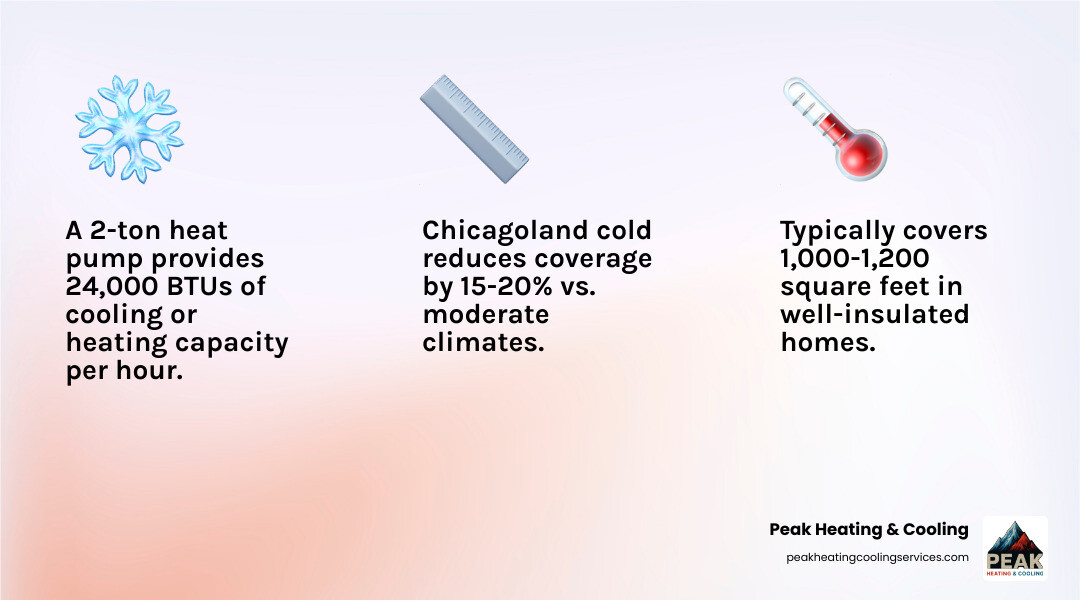
2 ton heat pump square footage coverage is typically 1,000 to 1,200 square feet — but that number shifts based on where you live, how well your home is insulated, and how it’s built. For those considering heat pump installation Glenview IL, these variables are essential.
Here’s a quick reference so you can see where a 2-ton unit fits:
| Home Size | Recommended Heat Pump Size |
|---|---|
| Up to 1,000 sq ft | 1.5 – 2 ton |
| 1,000 – 1,200 sq ft | 2 ton (24,000 BTU) |
| 1,200 – 1,500 sq ft | 2 – 2.5 ton |
| 1,500 – 1,800 sq ft | 2.5 – 3 ton |
| 1,800 – 2,400 sq ft | 3 – 4 ton |
A “2-ton” heat pump has nothing to do with weight. In HVAC, one ton equals 12,000 BTUs of heating or cooling capacity per hour — so a 2-ton unit moves 24,000 BTUs per hour. That’s enough to keep a well-insulated smaller home comfortable year-round.
But here’s the catch: those square footage numbers are just a starting point.
Chicagoland winters are brutal. A home in Glenview or Northbrook faces design temperatures that can push a heat pump to its limits. Ceiling height, window quality, insulation, air leaks, and ductwork all change how much capacity your home actually needs. A 2-ton unit that’s perfect for a tight, well-insulated ranch home may fall short in an older drafty two-story just a few blocks away.
Getting the size wrong — too big or too small — causes real problems: short cycling, humidity issues, high energy bills, and early equipment failure. Proper sizing isn’t just a technical detail. It’s the difference between a system that works and one that impacts your monthly budget.
This guide walks you through everything you need to know about heat pump installation Glenview IL and sizing correctly for your home.
Understanding 2 Ton Heat Pump Square Footage and Capacity
When we talk about a 2-ton heat pump, we are describing its ability to move heat. Unlike a furnace that creates heat by burning fuel, a heat pump acts like a heat transporter. In the summer, it pulls heat out of your home to keep you cool; in the winter, it reverses the process to bring heat inside.

A 2-ton system provides 24,000 BTUs (British Thermal Units) of capacity per hour. While the general industry baseline suggests this covers roughly 1,000 to 1,200 square feet, this is a “best-case scenario” estimate. According to Scientific research on HVAC verification, systems installed without proper verification and sizing can result in up to 30% higher energy use. This is why understanding the “tonnage” vs. “actual load” is so vital for homeowners in the North Shore and Northwest Suburbs.
How many BTUs are in a 2 ton heat pump square footage calculation?
The math is straightforward: 1 ton equals 12,000 BTUs per hour. Therefore, a 2-ton unit provides 24,000 BTUs. This measurement represents the amount of energy required to melt one ton of ice in a 24-hour period (an old industry standard that stuck!). In a 2 ton heat pump square footage calculation, we look at how those 24,000 BTUs match up against the heat loss of your home in the winter and the heat gain in the summer.
Is a 2 ton heat pump square footage rating enough for 1,500 sq ft?
In most Chicagoland applications, a 2-ton unit is likely undersized for a 1,500-square-foot home. For a space that size, we typically recommend a 2.5-ton or even a 3-ton system, depending on the home’s construction.
If you install a unit that is too small, it will suffer from “constant operation.” It will run 24/7 without ever reaching your desired temperature, leading to massive energy bills and a shortened equipment lifespan. If you are worried your current system can’t keep up, you can learn More info about heating contractor services to see how we evaluate capacity.
Factors That Influence Heat Pump Coverage
If square footage was the only factor, HVAC would be easy. But your home is a complex “envelope” that interacts with the outdoors.
Several variables determine if a 2-ton unit is actually sufficient:
- Insulation Quality: A home with modern spray foam or high-R-value fiberglass stays comfortable with less energy than a drafty 1950s bungalow.
- Window Efficiency: Double or triple-pane windows act as a barrier. Old, single-pane windows allow heat to pour out in January.
- Ceiling Height: Cooling 1,000 square feet with 8-foot ceilings is much easier than cooling the same footprint with 12-foot vaulted ceilings.
- Sun Exposure: South-facing windows can increase cooling needs by 10-20% in the summer.
Proper sizing also impacts indoor air quality. Data on dehumidification and sizing shows that a properly sized system acts as a dehumidifier. If the unit is too large, it cools the air so fast that it doesn’t run long enough to pull moisture out, leaving your home feeling “clammy” and increasing the risk of mold.
Impact of Climate Zones on System Performance
Chicagoland falls into a cold climate zone. In places like Glenview and Skokie, we design systems to handle “design temperatures”—the typical extreme lows we see each winter. While modern inverter-driven heat pumps from brands like Lennox or Ducane can maintain 100% capacity down to 5°F, they still work harder here than they would in Tennessee.
In our region, we often look at “supplemental heat.” This might involve electric heat strips or a dual-fuel setup. If you’re unsure how our local weather affects your equipment choice, you can find More info about HVAC contractor services.
Home Design and Ductwork Efficiency
Your ductwork is the “veins” of your HVAC system. If your ducts are leaky or undersized, it doesn’t matter how efficient your 2-ton heat pump is; the air won’t reach the rooms that need it. Older ducts can lose 20-30% of airflow through leaks in the attic or crawlspace. We perform airflow diagnostics to ensure your air handler is compatible with your existing ducts before any installation.
Why Proper Sizing Matters for Your Home
We often tell our customers in Wilmette and Winnetka that “bigger is not better” when it comes to HVAC.
When a system is perfectly sized, it runs in long, steady cycles. This provides even heating and cooling, better filtration, and lower energy bills. If you’re experiencing hot and cold spots, it might be a sign that your system is sized incorrectly or needs a tune-up. You can find More info about air conditioning repair service to help diagnose these comfort issues.
The Risks of Oversizing Your Heat Pump
If you put a 3-ton unit in a space that only needs 2 tons, you’ll experience “short cycling.” The unit kicks on, blasts the house with air, and shuts off five minutes later because it hit the target temperature. This constant on-and-off creates:
- Major Component Wear: The most stress on a compressor happens at startup.
- Humidity Problems: As mentioned, it won’t run long enough to dehumidify.
- Noise: Larger fans and higher air velocities can be loud and disruptive.
Consequences of an Undersized System
An undersized unit is a “no heat” emergency waiting to happen. During a Chicago polar vortex, an undersized heat pump simply won’t have the “oomph” to keep the house at 70 degrees. You’ll see your energy bills skyrocket as the system struggles, and you may eventually face frozen coils or a total system breakdown.
Professional Sizing vs. Rules of Thumb
For decades, the “rule of thumb” was 500 square feet per ton. By that logic, every 1,000-square-foot home needs a 2-ton unit. But we know better now.
At Peak Heating & Cooling, we don’t guess. We use the Manual J load calculation. This is the industry-standard method established by the Air Conditioning Contractors of America (ACCA). It accounts for every window, the direction your house faces, your insulation levels, and even how many people live in the home.
You can even play around with a Manual J load calculation tool yourself to see the variables involved, but for a guaranteed fit, a professional assessment is required.
Why Square Footage Rules Often Fail
Data from the Massachusetts Clean Energy Center (MassCEC) found that rules of thumb are almost always inaccurate. In many cases, homes were oversized by more than a full ton! Modern building standards have made homes much tighter. A new-construction home in Park Ridge might only need 1 ton for every 1,000 square feet, while a historic home in Wilmette might need double that.
The Importance of a Professional Assessment
When we visit your home in Chicagoland, we look at more than just the square footage. We might use thermal imaging to find hidden air leaks or perform airflow diagnostics on your vents. This allows us to create a customized comfort plan. For a full breakdown of how we evaluate your home, check out More info about HVAC services.
Efficiency Ratings and Climate Considerations
When shopping for a 2-ton unit, you’ll see ratings like SEER2 (for cooling) and HSPF2 (for heating).
In Illinois, these ratings are crucial. High-efficiency units often qualify for federal heat pump tax credits of up to $2,000. These incentives, combined with lower monthly utility bills, often make a high-efficiency 2-ton unit the most efficient choice over its 15-year lifespan.
Dual-Fuel and Ductless Alternatives
Sometimes, a standard central heat pump isn’t the best fit.
- Dual-Fuel: We pair an electric heat pump with a gas furnace. The heat pump handles the mild days, and the furnace kicks in when temperatures drop below freezing. This is a very popular “hybrid” solution for Skokie and Niles homeowners.
- Ductless Mini-Splits: If you have a room addition or a finished basement that stays too cold, a ductless system can provide targeted comfort without needing to tear into your walls for new ducts.
Financial Incentives and Long-Term Value
Between the Inflation Reduction Act and local utility programs, there has never been a better time to upgrade. You can use the Energy Star Rebate Finder to see what’s available in your zip code. To make these upgrades even easier, we offer 0% financing options for qualified customers, ensuring you don’t have to sacrifice comfort for your budget.
Frequently Asked Questions about Heat Pump Sizing
What square footage does a 2-ton heat pump typically cover?
Generally, a 2-ton unit covers 800 to 1,200 square feet. In a well-insulated, modern home in Glenview, it might push toward the higher end. In an older home with original windows, it might only handle 800 square feet effectively.
Can a 2-ton heat pump heat a whole house in Glenview, IL?
Yes, if the home is roughly 1,000 square feet and well-insulated. For larger homes, a 2-ton unit is often used for “zoning”—meaning it might only handle the second floor or a specific wing of the house while another unit handles the rest.
How do I find a qualified contractor for heat pump installation?
Look for a company that is licensed and insured, has a long history in the Chicagoland area, and holds 5-star reviews. Most importantly, ensure they perform a Manual J load calculation rather than just swapping out your old unit for the same size.
Conclusion
Sizing a heat pump is part science, part experience. While the 2 ton heat pump square footage rule of thumb is a helpful starting point, your home’s unique “fingerprint”—its insulation, windows, and layout—ultimately dictates what you need.
At Peak Heating & Cooling, we’ve spent over 20 years keeping our neighbors in Glenview, Northbrook, and the surrounding Chicagoland suburbs comfortable. Whether you need a new Lennox or Ducane heat pump installation Glenview IL or an emergency repair on your current unit, our family-owned team is here for you. We offer 24/7 emergency service, same-day repairs, and 0% financing to ensure your home stays a sanctuary regardless of the Illinois weather.
Don’t guess on your comfort. Schedule professional HVAC services today and let us ensure your system is the perfect fit.