
When Your AC Runs But Nothing Comes Out of the Vents
If you need to fix ac blower motor issues fast, here’s what to check first:
- Check the circuit breaker – Reset if tripped; if it trips again, stop and call a pro
- Replace the air filter – A clogged filter is the #1 cause of blower strain and failure
- Press the motor reset button – Usually a small red or black button on the motor housing
- Test the capacitor – A humming motor that won’t spin almost always points to a bad capacitor
- Call a licensed HVAC technician – For burning smells, grinding noises, or anything electrical beyond the basics
It’s a sweltering July afternoon in Glenview. Your AC is humming along — but no air is coming through the vents. The house is getting hotter by the minute.
The culprit is often the blower motor: the component responsible for pushing cooled air through your ductwork and into every room. Without it, even a perfectly functioning AC compressor is useless. The cold air just sits trapped inside the unit.
Blower motor problems range from a simple clogged filter to a failed capacitor to a completely burned-out motor. Some fixes take 10 minutes. Others require a licensed technician. This guide walks you through both — so you know exactly what you’re dealing with before spending a dime.
A well-maintained blower motor should last 10 to 20 years. Neglected ones can fail in under 10. The good news: most failures give you warning signs long before they quit completely.
Identifying Symptoms of a Failing Blower Motor
Before you grab your toolbox to fix ac blower motor issues, you need to know what a failing motor looks like. In our 20+ years of experience serving the North Shore, we’ve found that motors rarely “just die” without a struggle. They usually send out a few SOS signals first.
- No Airflow from Vents: This is the most obvious sign. You hear the outdoor unit kick on, but the house stays silent and the air remains still.
- Weak or Inconsistent Airflow: If the air feels like a faint breeze rather than a steady stream, the motor might be struggling to reach its required RPMs.
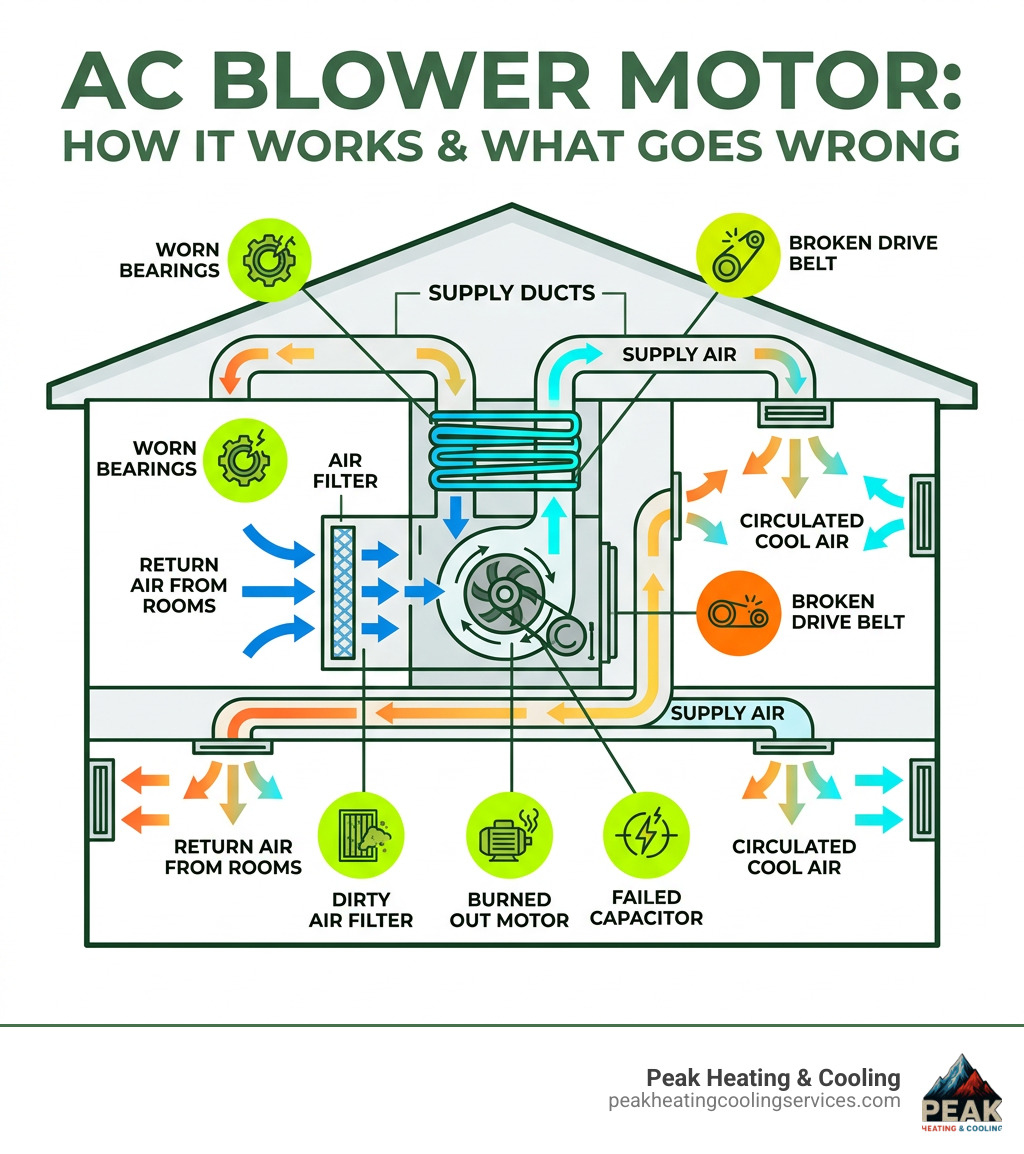
- Screeching or Squealing Sounds: High-pitched noises often indicate that the bearings are failing or the fan belt (in older units) is slipping.
- Grinding or Clunking: If it sounds like metal on metal, something is likely loose or the motor mounts have failed. This requires immediate attention to prevent the fan from shattering.
- The “Burning” Smell: An overheating motor often emits a distinct electrical burning odor. If you smell this, shut the system off at the breaker immediately.
- Intermittent Cycling: If the blower starts and then abruptly stops before the house is cool, it may be tripping its internal thermal overload switch.
- Tripped Circuit Breakers: A motor that is drawing too much “juice” because of internal friction or a short will trip your home’s breaker to prevent a fire.
If you are experiencing these issues, our Air Conditioning Repair Service can help diagnose the exact electrical or mechanical failure.
Common Causes of Airflow Malfunctions
Why do these motors fail in the first place? It’s rarely a mystery. Most of the time, the motor is simply working too hard against preventable obstacles.
- Clogged Air Filters: This is the #1 motor killer in Chicagoland. When a filter is packed with dust, the motor has to work twice as hard to pull air through. This leads to overheating and premature burnout.
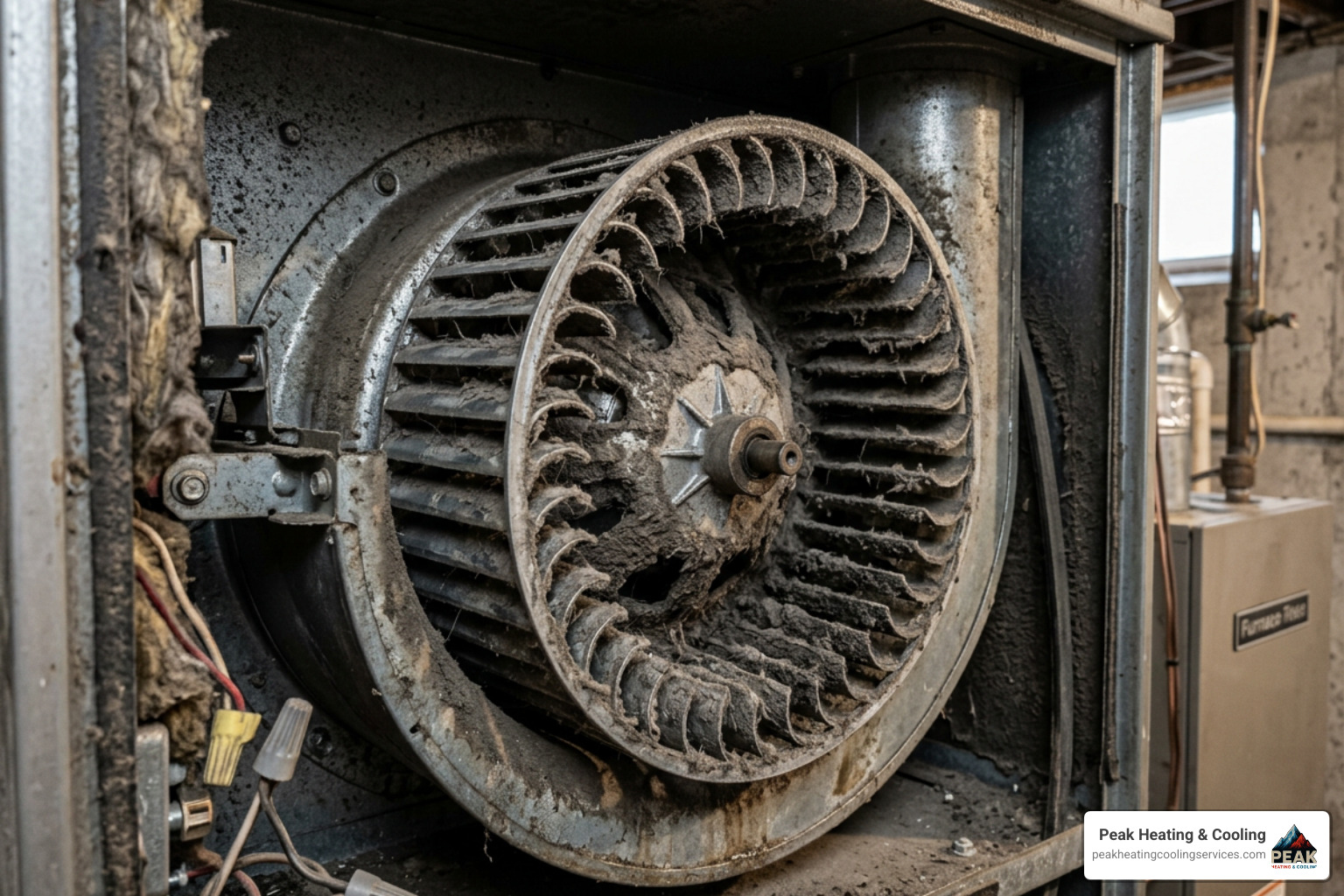
- Debris Accumulation: Dust and pet hair don’t just stop at the filter. They can coat the “squirrel cage” (the fan blades), unbalancing them and putting immense strain on the motor shaft.
- Worn Bearings: Over time, the lubricant in the motor bearings dries out. This creates friction, heat, and that dreaded squealing noise.
- Electrical Component Failure: Sometimes the motor itself is fine, but the parts that help it start—like the capacitor or the control board—have given up.
Understanding Your Motor Type
When you look to fix ac blower motor components, it helps to know what kind of motor you have. Most homes in areas like Northbrook and Skokie have one of two types:
| Feature | PSC Motor (Older/Standard) | ECM Motor (Modern/Efficient) |
|---|---|---|
| Full Name | Permanent Split Capacitor | Electronically Commutated Motor |
| Speed | Fixed (Single or Multi-speed) | Variable (Adjusts to demand) |
| Efficiency | Lower (Uses more electricity) | Higher (Saves on energy bills) |
| Repair Factor | Often uses a separate capacitor | Uses a built-in control module |
For visual learners, you can find excellent YouTube repair guides that show these motors in action.
Testing the Capacitor to Fix AC Blower Motor Issues
Nearly 20% of the calls we get for “dead” motors are actually just failed capacitors. Think of the capacitor as a high-powered battery that gives the motor the “kick” it needs to start spinning.
To test it, you’ll need a multimeter with a capacitance setting. After safely disconnecting the power, you must discharge the capacitor (it holds a dangerous electrical charge even when the power is off) by touching an insulated screwdriver across the terminals. If the multimeter reading is more than 10% off the rated value printed on the side of the part, it’s time for a replacement. Regular HVAC Maintenance is the best way to catch a weak capacitor before it leaves you in the heat.
Cleaning and Lubrication to Fix AC Blower Motor Performance
If your motor is just noisy or running hot, a good cleaning might be the only “fix” you need. Dust acts as insulation, trapping heat inside the motor housing. Use a shop vac and a soft brush to remove dust from the motor vents and the squirrel cage blades.
Some older motors have oil ports. If yours does, a few drops of non-detergent SAE 20 oil can quiet a squeaky bearing. However, most modern motors are “sealed for life” and cannot be lubricated. If a sealed motor is squealing, it usually needs to be replaced. If you notice ice forming while the blower is struggling, you might also be dealing with a refrigerant issue; see our guide on AC Gas Leak Repair for more details.
Step-by-Step Guide to Fix AC Blower Motor Components
If you’ve determined the motor itself is the problem, here is the general process for replacement. Warning: HVAC systems involve high voltage and heavy components. If you are not comfortable with electrical work, call us for same-day service.
- Disconnect the Power: Turn off the AC at the thermostat, then flip the dedicated breaker in your electrical panel. Use a multimeter to verify there is zero voltage at the unit. Safely disconnect power protocols are essential here.
- Access the Blower: Remove the access panel on your furnace or air handler. You’ll see the large metal housing (the blower deck).
- Document the Wiring: Take a clear photo of the wires connecting the motor to the control board. You will need this to ensure the new motor spins in the right direction!
- Remove the Assembly: Disconnect the wires and unscrew the mounting bolts holding the blower housing in place. Slide the entire “drawer” out.
- Detach the Motor: Loosen the set screw holding the fan (squirrel cage) to the motor shaft. Remove the bolts holding the motor to the housing.
- Install the New Motor: Reverse the steps, ensuring the set screw is tightened onto the “flat” side of the motor shaft.
If this feels overwhelming, our team provides expert HVAC Repair across the North Shore to get it done right the first time.
Repair vs. Replacement: Making the Right Choice
Should you fix ac blower motor issues or replace the whole system? In Glenview and the surrounding suburbs, we see many systems from the early 2000s reaching the end of their lives.
- The $1,000 Rule: If a professional blower motor replacement is approaching $800–$1,000 and your system is over 15 years old, a replacement is often the smarter financial move.
- Refrigerant Changes: Older systems use R-22 (Freon), which is now phased out and incredibly expensive to service. Modern systems use R-410A (which is also beginning its phase-out) or newer, more eco-friendly refrigerants.
- Efficiency Gains: Replacing a 20-year-old system with a new Lennox or Ducane unit can slash your summer cooling bills by up to 30%.
Check out our Don’t Blow It: HVAC Maintenance Roadmap to see where your system stands in its lifecycle.
Professional HVAC Services in Glenview, IL
At Peak Heating & Cooling, we’ve spent over two decades keeping Chicagoland comfortable. We know that when your AC fails, you don’t want to wait three days for a part. That’s why we offer same-day repairs and 24/7 emergency service for those sweltering nights when the air just won’t move.
We serve a wide area including:
- Glenview & Northbrook
- Wilmette, Winnetka, & Glencoe
- Skokie & Morton Grove
- Park Ridge, Niles, & Des Plaines
As a licensed and insured HVAC Contractor, we stand behind our work with a 100% satisfaction guarantee.
Frequently Asked Questions about Blower Motor Repair
Why is my AC blower humming but not spinning?
This is the classic symptom of a bad capacitor. The motor is getting power (the hum), but it doesn’t have the electrical “push” to start turning. In some cases, it could also be seized bearings. Try the reset button on the motor housing first; if that doesn’t work, the capacitor is the likely culprit.
Can I run my AC if the blower motor is bad?
No. If the blower isn’t moving air, the evaporator coils inside your home will quickly drop below freezing. This causes the coils to “ice up,” which can send liquid refrigerant back to your compressor, potentially destroying the most expensive part of your AC system. If the fan isn’t blowing, turn the system off immediately.
How often should I change my air filter to protect the motor?
In the Chicagoland area, we recommend inspecting your filter every month. If you have pets or live near high-traffic areas with more dust, you’ll likely need to replace it every 30 to 60 days. A clean filter is the cheapest insurance policy you can buy for your blower motor.
Conclusion
A broken blower motor doesn’t have to mean a ruined summer. Whether it’s a simple capacitor swap or a full motor replacement, most issues can be resolved quickly by a pro. At Peak Heating & Cooling, we combine 20+ years of experience with a neighborly approach to service. We offer 0% financing for qualified customers on new installations and are always ready for an emergency.
Don’t stay sweltering in a stuffy house. Explore our full range of Services or call us today to get your airflow back to peak performance!