

When the Heat Goes Out, Business Stops: What Every Chicagoland Property Owner Needs to Know
Commercial HVAC emergency services exist for one reason: when your building’s climate control fails, every minute without a fix is money walking out the door.
Whether you manage an office building in Glenview, a restaurant on the North Shore, or a retail space in Northbrook – a heating or cooling failure doesn’t just make people uncomfortable. It shuts down operations, drives away customers, and can create serious safety and legal issues fast. According to U.S. Department of Energy guidance on commercial buildings, maintaining efficient systems is vital for operational stability.
Here’s a quick overview of what you need to know right now:
What qualifies as a commercial HVAC emergency?
- Complete loss of heating or cooling during extreme weather
- Gas odors or burning smells from HVAC equipment
- Refrigerant leaks or electrical failures
- No airflow throughout the building
- Walk-in cooler or freezer failure (food service)
- Cooling failure in a server room or medical space
How quickly can help arrive? Reputable providers target a 2-4 hour response for critical commercial failures. Businesses with maintenance contracts typically receive priority dispatch.
What is the impact of a failure?
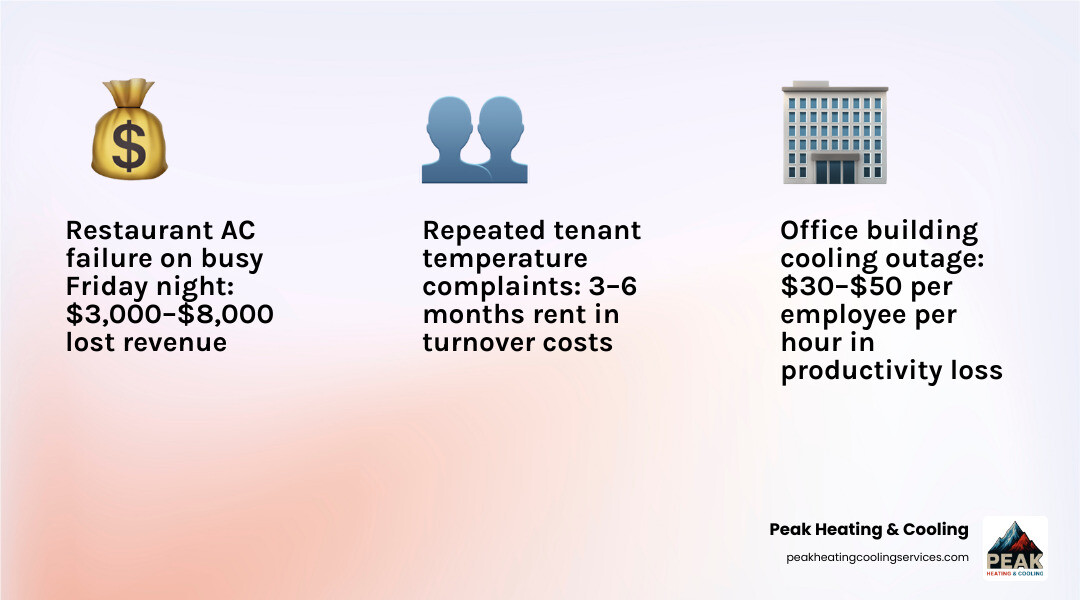
- A restaurant losing AC on a busy Friday night: significant loss in nightly revenue
- An office building with AC down: substantial drop in employee productivity
- Repeated temperature complaints from tenants: months of lost rent in turnover and vacancy
The bottom line: a commercial HVAC failure is a business emergency – not just a comfort issue.
This guide walks you through everything: how to identify a true emergency, what the response process looks like, how to decide between repair and replacement, and how to choose a trusted local provider like Peak Heating & Cooling to keep your Chicagoland property protected year-round.
Simple commercial hvac emergency services glossary:
What Qualifies as a Commercial HVAC Emergency?
In commercial property management, not every service call is an emergency. However, when a situation threatens your building’s safety, your inventory, or your ability to remain open, it’s time to call for commercial HVAC services.
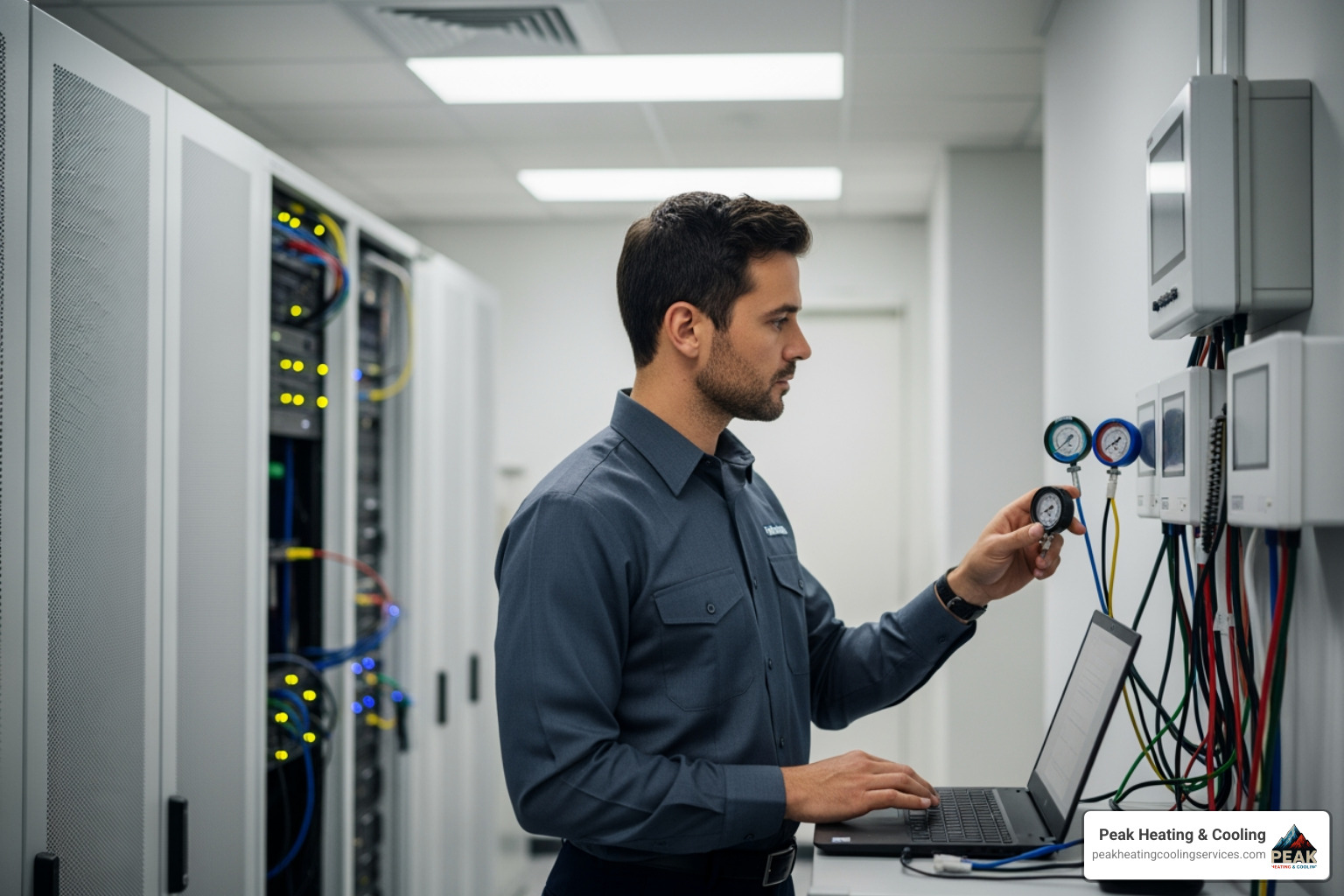
A true emergency involves a total system failure during a February freeze or a humid July afternoon. It also includes hazardous situations like gas odors or burning smells emanating from your vents. In specialized environments like medical offices or data centers, even a slight temperature deviation can be catastrophic. If your Rooftop Unit (RTU) stops moving air or your server room starts overheating, you are facing a critical failure that requires immediate professional intervention.
Identifying Critical Failure Warning Signs
Often, your system will try to tell you something is wrong before it quits entirely. Keep a sharp eye (and ear) out for these red flags:
- Unusual Noises: Grinding, squealing, or loud banging from the RTU often indicates a motor or belt failure.
- Burning Smells: This could be electrical components overheating or an motor burning out.
- High Humidity: If your office feels “sticky,” the AC is likely failing to dehumidify, which can lead to mold issues.
- Uneven Temperatures: Drastic differences between floors or rooms suggest a ductwork issue or a failing compressor.
- Refrigerant Leaks: Hissing sounds or ice buildup on coils are signs of a leak that will eventually kill the system.
Specialized Environments and High-Stakes Needs
Certain businesses have zero tolerance for HVAC downtime. In medical and dental offices, stable temperatures are non-negotiable for patient comfort and the protection of sensitive medications. Data centers and telecom closets require “critical space cooling”; even a few hours without AC can cause irreversible hardware damage. For restaurants and warehouses, temperature management is a matter of food safety and inventory protection. If the cooling fails, thousands of dollars in product can spoil in a single afternoon.
The High Stakes of Downtime: Why 24/7 Commercial HVAC Emergency Services Matter

When your system goes down, the clock starts ticking on your revenue. Why emergency heating and cooling is a total lifesaver becomes clear the moment you realize that an uncomfortable building is an empty building. Customers won’t stay in a retail shop that is 85 degrees, and employees can’t work effectively when they are shivering at their desks.
Impact of System Failure
The financial fallout of an HVAC failure is significant. In an office setting, productivity drops significantly when temperatures fall outside the comfort range. Estimates suggest a substantial loss in output per employee. For a large office, a full day of AC failure could result in a major hit to your company’s bottom line.
Tenant retention is another major factor for property managers in Glenview and Northbrook. Temperature issues are the primary reason tenants choose not to renew their leases. Replacing a commercial tenant can lead to months of vacancy and broker fees. Rapid response isn’t just about fixing a machine; it’s about protecting your investment.
Maintaining Regulatory and Safety Standards
Beyond the balance sheet, there are legal and safety requirements to consider. Health departments mandate specific temperatures for food storage and preparation. Workplace safety regulations require a habitable environment for workers. In the Chicagoland area, “no heat” situations in the winter can be a code violation, potentially leading to fines or legal liability if pipes freeze and burst, causing extensive water damage.
The Emergency Response Process: From Initial Call to System Restoration
When you call for emergency HVAC services near me, you need to know exactly what happens next. At Peak Heating & Cooling, we prioritize commercial calls because we understand the urgency. Our dispatch protocols are designed to get a technician to your site as quickly as possible, often targeting a 2-to-4-hour window for critical failures.
Immediate Steps for Facility Managers
While you wait for our technician to arrive, there are a few things you can do to help:
- System Shutdown: If you smell burning or hear loud mechanical grinding, turn the system off at the thermostat or disconnect switch to prevent further damage.
- Clear Access: Ensure the path to the mechanical room or the rooftop ladder is clear.
- Check the Basics: Quickly verify if a circuit breaker has tripped or if the thermostat batteries are dead.
- Communicate: Let your staff or tenants know that help is on the way to manage expectations.
Restoration and Temporary Solutions
Our technicians arrive in fully stocked “mobile warehouses.” This allows us to maintain a high first-call resolution rate, fixing common issues like capacitors, contactors, or belts on the spot. If a major component like a compressor needs to be ordered, we can often provide temporary solutions like spot coolers to keep your most critical areas—like a server room—operational while the permanent repair is finalized.
Strategic Decision Making: Repair vs. Replacement and the Age Factor
In the middle of an emergency, you have to decide: do I fix this old unit one more time, or is it time for an air conditioning repair service to become a full replacement? We often recommend the “Repair vs. Replace Rule” for our Chicagoland clients.
If the expense of the repair is substantial, or if the unit is over 15 years old and requires a major component like a heat exchanger or compressor, replacement is usually the smarter financial move. Modern units are significantly more energy-efficient, often paying for themselves through lower utility bills and reduced emergency call-outs.
[TABLE] Comparing Emergency Repair vs. Planned Replacement
| Feature | Emergency Repair | Planned Replacement |
|---|---|---|
| Speed | Same-day restoration | Scheduled over 1-2 days |
| Initial Investment | Lower (Immediate fix) | Higher (Capital investment) |
| Efficiency | Remains at current level | Up to 30% energy savings |
| Warranty | Part-specific only | Full manufacturer warranty |
| Reliability | Potential for future failure | 15-20 year lifespan |
Proactive Resilience: Preventing HVAC Emergencies with Modern Technology
The best way to handle a commercial hvac emergency services call is to prevent it from ever happening. Modern technology has changed the game for property owners in Glenview and Wilmette. Building Automation Systems (BAS) and smart thermostats allow us to monitor your system’s performance in real-time. We can often see a motor starting to draw too much power or a temperature spike before your tenants even notice a problem.
The Value of Maintenance Agreements
Facilities with a comprehensive HVAC maintenance plan experience a significant reduction in emergency failures. When you are a maintenance contract member with Peak Heating & Cooling, you get:
- Priority Response: You go to the front of the line during heatwaves.
- Lower Expenses: Regular tune-ups prevent small issues from becoming major disasters.
- Extended Lifespan: Clean coils and well-lubricated motors last years longer.
Choosing the Right Commercial HVAC Emergency Services Provider
Don’t trust your business to just anyone with a van. When searching for emergency HVAC service Chicagoland, look for these credentials:
- Licensed and Insured: This is non-negotiable for commercial work.
- Experience: Look for a company with 20+ years in the local market.
- Local Roots: A family-owned company like ours understands the specific needs of North Shore businesses.
- Brand Expertise: Ensure they are trained on major brands like Lennox and Ducane.
Regional Considerations for Chicagoland Commercial HVAC
Our weather in Illinois is brutal on mechanical systems. From the sub-zero winters that stress boilers and furnaces to the humid summers that push RTUs to their limits, your HVAC system needs to be built for the Midwest. We specialize in winter prep for Chicagoland businesses, ensuring your heating system can handle a polar vortex without skipping a beat.
Frequently Asked Questions about Commercial HVAC Emergency Services
What is the typical response time for a commercial emergency in the North Shore?
For critical failures, we aim to be on-site within 2 to 4 hours. Our goal is always same-day repair to ensure your business stays open.
How do maintenance contracts affect emergency priority for local businesses?
Maintenance contract holders receive “Priority Dispatch.” During extreme weather events when call volumes are high, our contract members are serviced first.
Can emergency services handle commercial rooftop units and multi-zone systems?
Yes. Our technicians are NATE-certified and specifically trained to work on complex commercial equipment, including RTUs, split systems, and multi-zone configurations common in Glenview and Park Ridge office buildings.
Conclusion
At the end of the day, your HVAC system is the backbone of your business operations. Whether it’s a furnace failure in the middle of a January night or an AC breakdown in July, Peak Heating & Cooling is ready to help. We offer 24/7 emergency service, same-day repairs, and 0% financing options for new installations to help our neighbors in Glenview and the surrounding suburbs maintain “business as usual.”
Don’t let a mechanical failure shut you down. Schedule commercial HVAC emergency services today and get the peace of mind that comes with professional, local expertise.