

Why More Chicagoland Homeowners Are Installing a Mini Split AC System
Installing a mini split ac system is one of the most effective upgrades a homeowner can make for flexible, energy-efficient comfort — whether you’re cooling a bonus room, a converted garage, or an entire home without ductwork.
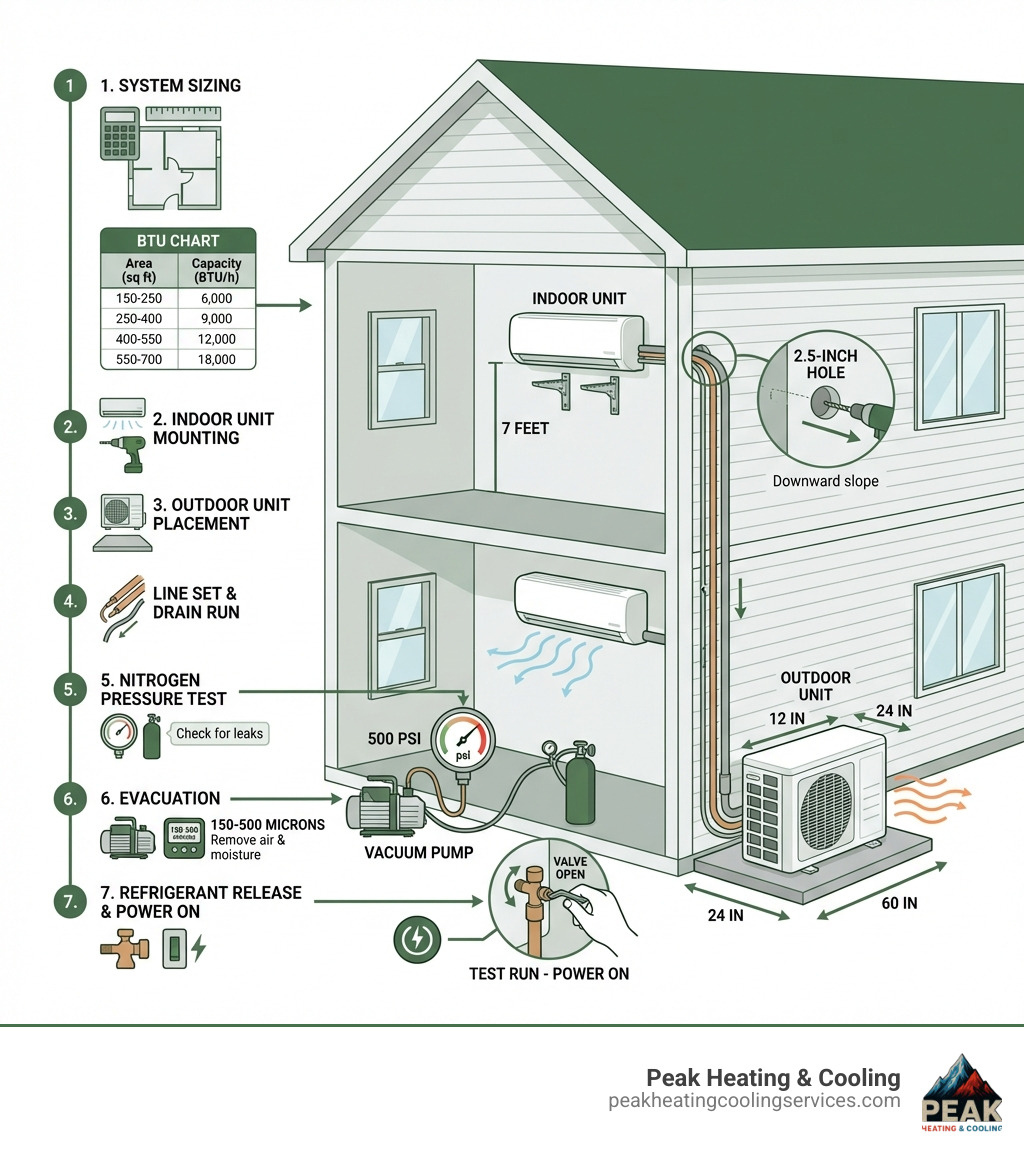
Here’s a quick overview of what the installation process involves:
- Choose and size your system — Match BTU capacity to your room’s square footage and climate needs
- Mount the indoor unit — Attach the wall bracket, drill a 2.5-inch hole for the line set, and mount the air handler roughly 7 feet from the floor
- Place the outdoor unit — Set on a level pad with proper clearance for airflow
- Connect the line set — Run refrigerant lines, drain line, and electrical wiring through the wall
- Pressure test and evacuate — Use nitrogen to test for leaks, then vacuum the system down to 150–500 microns
- Release refrigerant and power on — Open the service valves and run a test cycle
Important: Handling refrigerant requires an EPA 608 certification. Electrical work should be done by a licensed professional. Most manufacturers will void the warranty without professional installation.
Mini splits are gaining popularity fast — and for good reason. Traditional ducted systems can waste up to 30% of energy through duct losses alone. Mini splits eliminate that waste entirely. And with installed systems ranging in complexity from a single-zone bedroom unit to a whole-home multi-zone setup, there’s a configuration for nearly every situation.
But the installation process has real technical demands. The wrong flare on a copper line, a vacuum that doesn’t go deep enough, or an undersized circuit can cause years of problems — or worse, void your warranty on day one.
This guide walks you through every stage of the process — from sizing and planning to mounting, wiring, refrigerant handling, and first startup. Whether you’re a confident DIYer or trying to understand what a professional installer should be doing, you’ll find clear, honest answers here.
Understanding Ductless Technology and System Components
At its core, a ductless mini-split is a type of heat pump that moves heat rather than creating it. During a hot July day in Glenview, it pulls heat from inside your home and dumps it outside. In the winter, it reverses the process, extracting heat from the outdoor air to keep you warm.
The system consists of two primary parts: the indoor air handler (the evaporator) and the outdoor condenser unit. These are connected by a “line set,” which includes two copper refrigerant lines, a power cable, and a condensate drain line.
Key Components and Technology
- Inverter Technology: Unlike old-school AC units that are either “all on” or “all off,” modern mini-splits use inverter-driven compressors. This allows the system to speed up or slow down smoothly, maintaining a rock-steady temperature while using significantly less electricity.
- Evaporator Coil: Located in the indoor unit, this is where the refrigerant absorbs heat from your room’s air.
- Condenser Unit: The “muscle” of the system that sits outside on a pad or wall bracket.
- Single-Zone vs. Multi-Zone: A single-zone system has one indoor unit for one outdoor unit. Multi-zone systems allow you to connect up to five or more indoor units to a single, larger outdoor compressor, giving you independent temperature control for every room.
Whether you prefer a standard wall-mounted unit, a floor-mounted console, or a sleek ceiling cassette, the technology remains the same. By eliminating ductwork, you avoid the common “duct loss” that plagues central air systems, where cooled air leaks into attics or crawlspaces before reaching your living room. For more specialized help with these components, you can explore our full range of Services.

Sizing and Planning for Installing a Mini Split AC System
Before you pick up a drill, you need to know exactly how much cooling power you need. In the HVAC world, we measure this in BTUs (British Thermal Units). If you undersize the unit, it will run constantly and never get the room cold. If you oversize it, the unit will “short cycle,” turning on and off so fast that it fails to remove humidity, leaving your home feeling clammy.
How to Calculate BTUs
While a general rule of thumb is 20 BTUs per square foot, real-world conditions in the Chicagoland area require more nuance. Professionals use the Air Conditioning Contractors of America as a guide to perform a “Manual J” load calculation. This takes into account:
- Insulation Quality: Older homes in Wilmette or Winnetka may have less insulation than new builds in Northbrook.
- Window Placement: Large, south-facing windows add a massive heat load in the summer.
- Ceiling Height: Rooms with vaulted ceilings require more BTUs to cool the larger volume of air.
- Usage: A kitchen with a hot stove needs more cooling than a quiet bedroom.
BTU Requirement Table
| Room Size (Sq. Ft.) | Capacity Needed (BTU) |
|---|---|
| 150 – 250 | 6,000 |
| 250 – 450 | 9,000 |
| 450 – 550 | 12,000 |
| 550 – 700 | 18,000 |
| 700 – 1,000 | 24,000 |
Note: For every foot of line set over the factory charge (typically 25 feet), you may need to add 0.2 to 0.5 ounces of refrigerant depending on the tube size.
Step-by-Step Guide to Mounting and Connection
Installing a mini split ac system requires a specific set of tools. If you are going the DIY route, expect to spend about $950 on the “specialty” toolset alone. This includes a 45-degree flaring tool, a torque wrench, a vacuum pump, a micron gauge, and a nitrogen tank with a regulator. For a visual walkthrough, this Step-by-step video guide is an excellent resource.
Preparing the Wall for Installing a Mini Split AC System
- Locate Studs: Use a stud finder to find a solid mounting point. The indoor unit is heavy and vibrates slightly; it needs to be secure.
- Mount the Bracket: Ensure the bracket is perfectly level. If the unit is tilted, the condensate water won’t drain properly, and you’ll end up with a puddle on your floor.
- Drill the Hole: Use a 2.5-inch hole saw to drill through the wall. Crucial Tip: Drill at a slight downward angle toward the outside. This allows gravity to pull the condensate water out of the house.
- Clearance: Ensure there is at least 6-12 inches of open space above and on the sides of the unit for proper airflow.
Technical Steps for Installing a Mini Split AC System Safely
Once the indoor unit is clicked onto its bracket and the lines are fed through the wall, it’s time to move outside.
- Set the Pad: Place the outdoor unit on a level plastic or concrete pad. In our snowy Illinois winters, we recommend mounting the unit at least 8-12 inches above the ground to prevent snow from blocking the coil.
- The Flare Connection: This is where 90% of DIY installs fail. You must use a high-quality flaring tool to create a perfect 45-degree flare on the copper tubing. Any burrs or uneven edges will cause a refrigerant leak.
- Torque to Spec: Use a torque wrench to tighten the flare nuts. Over-tightening can crack the flare, while under-tightening leads to leaks.
- Nitrogen Pressure Test: Before releasing refrigerant, pressurize the lines with dry nitrogen to about 500 psi. Let it sit for at least 15-60 minutes. If the pressure drops, you have a leak.
- The Deep Vacuum: Connect your vacuum pump and micron gauge. You must pull the system down to at least 500 microns (ideally 150-350) and hold it there. This removes moisture and “non-condensables” that would otherwise destroy your compressor.
- Refrigerant Release: Only after the vacuum test is successful should you open the service valves to release the pre-charged refrigerant into the lines.
Electrical Requirements and Refrigerant Safety
Electricity and refrigerant are the two most dangerous parts of installing a mini split ac system. Most systems require a dedicated 240V circuit run directly from your main electrical panel to an outdoor disconnect box located near the condenser.
- Surge Protection: We strongly recommend installing a surge protector at the disconnect box. The sensitive inverter boards in mini-splits are expensive to replace if a power surge hits your Chicagoland neighborhood.
- EPA 608 Certification: Federal law requires anyone handling or purchasing refrigerant to be EPA 608 certified. While many DIY kits come “pre-charged,” any task involving adding or recovering refrigerant must be handled by a professional.
- Pressure Hazards: R-410A refrigerant operates at pressures 1.6 times higher than older R-22 systems. Using the wrong gauges or hoses can lead to equipment failure or serious injury.
If the thought of running high-voltage wire or handling high-pressure gas makes you nervous, it’s best to call in Licensed HVAC contractor services to handle the final connections and startup.
Frequently Asked Questions about Mini-Split Installation
How do I maintain my mini-split after installation?
Maintenance is simple but vital. You should clean the indoor filters every month—just pop them out and rinse them in the sink. Outside, keep the condenser clear of grass clippings, leaves, and snow. We also recommend an annual professional tune-up to check refrigerant levels and clean the outdoor coils to ensure the system lasts its full 15-20 year lifespan.
Can I install a mini-split on an interior wall?
Yes, but it’s more complicated. Since you can’t rely on a simple gravity drain, you will need to install a condensate pump to push the water up into an attic or across a ceiling. This adds noise and another potential failure point, so we usually recommend sticking to exterior walls whenever possible.
What are the risks of DIY installation?
The biggest risk is voiding your warranty. Most major brands, like Lennox or Ducane, require proof of professional installation for warranty claims. Additionally, a small refrigerant leak—which is hard to detect without the right tools—can lead to the compressor burning out within a year or two, costing you thousands in repairs.
Conclusion
Installing a mini split ac system is a fantastic way to bring modern comfort to your home, but it requires precision and the right tools to do correctly. From sizing the BTUs to pulling a deep vacuum, every step matters for the long-term health of your system.
At Peak Heating & Cooling, we’ve spent over 20 years helping our neighbors in Glenview, Northbrook, and across the North Shore stay comfortable. We specialize in the installation and repair of high-quality systems like Lennox and Ducane. Whether you need a hand finishing a DIY project or want a professional team to handle the entire job from start to finish, we’re here to help.
We offer 0% financing options for qualified customers and provide 24/7 emergency support to ensure you’re never left in the heat. Ready to upgrade your home’s comfort? Contact a professional HVAC contractor at Peak Heating & Cooling today for a reliable, honest consultation.