

Is a House AC Installation Right for You This Summer?
House AC installation is one of the most impactful upgrades a Chicagoland homeowner can make — especially when summer temperatures push into the 90s and humidity makes every room feel unbearable.
Here’s a quick overview of what to expect:
- System types: Split systems (most common) or packaged units
- Right size matters: Requires a Manual J load calculation — not just square footage
- Efficiency to look for: SEER2 ratings of 14–20 in 2025; higher ratings mean lower energy consumption
- Professional installation is essential: Improper installs can reduce system efficiency by up to 30%
Whether your old unit finally gave out during a Glenview heat wave or you’re adding central AC to a home that’s never had it, the process involves more than just swapping out equipment. Sizing, ductwork, permits, and proper refrigerant handling all play a role in whether your new system runs efficiently for 12–15 years — or causes headaches from day one.
This guide walks you through everything: how central AC works, what the installation process looks like, how to choose the right system, and how to protect your investment long-term.
Terms related to house ac installation:
Understanding Central Air Conditioning Systems
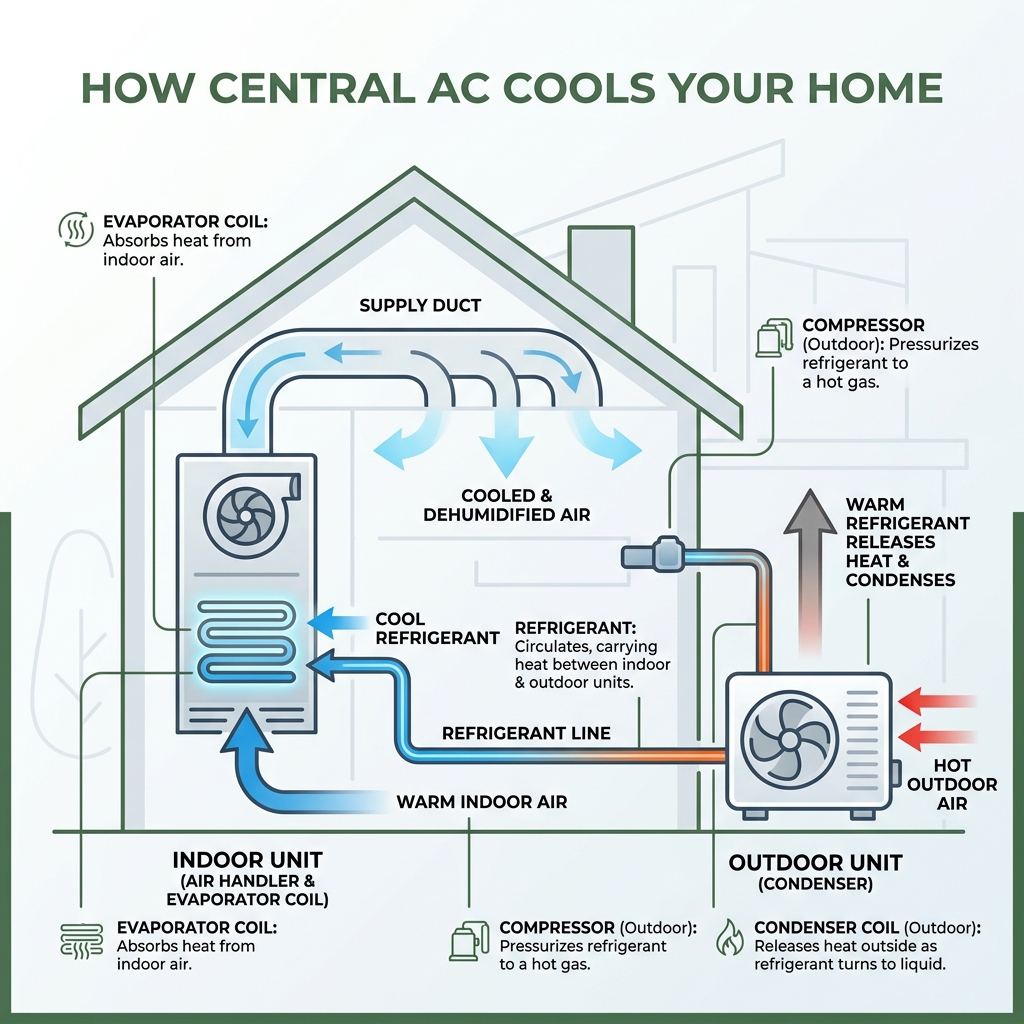
To understand why a professional house ac installation is so complex, it helps to know how the system actually works. Central air conditioning doesn’t just “create” cold air; it’s a heat transfer machine. By fighting a perpetual uphill battle against science, the system absorbs heat from inside your home and pumps it outdoors.
Split Systems vs. Packaged Units
Most homes in the North Shore area use a split system. This consists of an indoor evaporator coil (usually sitting on top of your furnace) and an outdoor condenser unit. These two parts are connected by copper refrigerant lines.
In contrast, a packaged unit houses all components—the compressor, condenser, and evaporator—in one large cabinet located outside. These are less common in residential Glenview homes but are often used in commercial settings or homes with limited indoor space.
The Refrigerant Cycle
The heart of the system is the refrigerant. This specialized fluid circulates through the system, changing from liquid to gas as it absorbs heat at the indoor coil. An indoor air handler (often your furnace blower) pulls warm air from your rooms through return ducts, passes it over the cold coils, and then pushes the newly cooled air back through the supply vents. The absorbed heat is then sent to the outdoor condenser, where it is released into the air.
The Step-by-Step House AC Installation Process
When we arrive at your home in Northbrook or Park Ridge for a house ac installation, we follow a rigorous HVAC Installation protocol to ensure your system operates safely and efficiently.
- Site Evaluation and Prep: We begin by verifying the placement of the outdoor unit. It needs to be on level ground with plenty of airflow. We also protect your home’s interior using drop cloths and floor coverings.
- Permit Acquisition: Before the first bolt is turned, we ensure all local building permits for Glenview or Cook County are secured. This protects your home’s resale value and ensures the work meets local safety codes.
- Old System Removal: We safely recover the old refrigerant according to EPA regulations. The old condenser and indoor coils are then removed and hauled away for proper recycling.
- Refrigerant Line Flushing: If we are using existing copper lines, we perform a thorough flush to remove contaminants. Any microscopic debris left behind can destroy a new high-efficiency compressor.
- New System Installation: We install the new indoor evaporator coil and the outdoor condenser. We then connect the new refrigerant lines and the condensate drain line, which carries away the moisture pulled from your indoor air.
- Electrical and Controls: Our technicians handle the high-voltage wiring to the outdoor unit and the low-voltage wiring for your thermostat. We ensure the electrical panel can handle the new load.
- Testing and Startup: This is the most critical phase. We pull a vacuum on the system to remove moisture, charge it with the precise amount of refrigerant, and test the airflow across all vents.

Comparing AC System Types
| Feature | Split System | Packaged Unit |
|---|---|---|
| Location | Indoor coil + Outdoor condenser | All-in-one outdoor cabinet |
| Common Use | Most residential homes | Commercial or space-constrained homes |
| Efficiency | Generally higher SEER2 options | Compact but can be less efficient |
| Maintenance | Access in two locations | All components in one outdoor spot |
Key Considerations for System Efficiency
Efficiency isn’t just a buzzword; it’s the difference between a system that operates smoothly and one that strains your home’s energy resources. In 2025, new central AC systems are required to meet higher SEER2 (Seasonal Energy Efficiency Ratio) standards.
SEER2 Ratings and Energy Savings
Think of SEER2 like the MPG rating on a car. The higher the number, the less energy the unit uses to cool your home. Standard units usually start around 14 SEER2, while high-efficiency models can reach 20 or higher. Replacing a 10-year-old system with a modern high-efficiency model can significantly reduce your annual energy usage.
The Importance of a Manual J Calculation
One of the biggest mistakes a contractor can make is sizing a unit based solely on square footage. We use a manual J calculation to estimate your anticipated heating and cooling needs. This calculation looks at:
- The orientation of your home (which rooms get afternoon sun).
- Insulation levels in your attic and walls.
- The number and type of windows.
- The number of occupants in the home.
An oversized unit will “short-cycle,” turning on and off rapidly, which wears out the motor and fails to remove humidity. An undersized unit will run constantly, struggling to keep the house cool on a hot Skokie afternoon.
Humidity Control and Variable-Speed Compressors
Modern systems, particularly those from brands like Lennox and Ducane, often feature variable-speed compressors. Unlike older units that are either 100% “on” or “off,” these systems can run at lower speeds for longer periods. This provides much better humidity control and keeps your indoor temperature consistent within half a degree.
Determining the Right Size for House AC Installation
Sizing is measured in “tons.” One ton of cooling is equivalent to 12,000 BTUs per hour. Most residential homes require between 1.5 and 5 tons of cooling. Getting the sizing right is the single most important factor in the longevity of your house ac installation.
Professional Standards for House AC Installation
We take pride in maintaining the highest professional standards. Our technicians are NATE-certified, meaning they have passed rigorous national testing for HVAC excellence. Furthermore, we strictly follow EPA Section 608 guidelines for refrigerant handling. Refrigerant is toxic and must be handled with specialized equipment to prevent environmental damage and health risks.
During a Air Conditioning Repair Service or a new install, we also ensure your ductwork is sealed. Leaky ducts can waste energy before the air even reaches your living room.
Financing and Long-Term Value
A new house ac installation is a significant investment. We want to make sure it’s accessible for our neighbors in Des Plaines and Wilmette. That’s why we offer 0% financing options available for qualified customers.
Financial Incentives
Beyond our internal payment plans, there are several ways to offset the investment:
- Federal Tax Credits: Under the Inflation Reduction Act (Section 25C), you may qualify for a tax credit for high-efficiency central AC units.
- Utility Rebates: Many local Illinois utility providers offer rebates for installing ENERGY STAR-certified equipment.
- Increased Home Value: A modern, efficient HVAC system is a major selling point. In neighborhoods where central AC is less common, it can significantly boost your home’s resale value.
To learn more about managing the investment, check out our guides on How to Finance Your AC Unit Without Losing Your Cool and Chill Out with These Easy AC Monthly Payment Plans.
Frequently Asked Questions about House AC Installation
How long does a typical installation take?
For a standard house ac installation where we are replacing an existing unit, the process usually takes 8 to 10 hours (one full day). However, if your home requires significant ductwork modifications or electrical panel upgrades, it may take 2 to 3 days. We always provide a clear timeline during our initial site evaluation so you can plan accordingly.
What are the signs that I need a new system?
If you’re constantly calling for AC repair in Skokie, it might be time for a replacement. Watch for these red flags:
- Age: Most central AC systems typically last between 12 to 15 years. If yours is over 10 years old, its efficiency is likely declining.
- Frequent Repairs: If you’ve spent a significant amount on repairs in the last two years, replacement is the smarter financial move.
- Rising Energy Usage: A sudden spike in your energy usage often means the compressor is struggling to keep up.
- Strange Noises: Grinding, squealing, or banging sounds often indicate a major component failure is imminent.
- Inconsistent Temperatures: If the living room is an ice box but the bedrooms are sweltering, the system is no longer distributing air effectively.
What kind of maintenance is recommended for a new AC system?
Your new system is an investment that needs protection. We recommend:
- Filter Changes: Changing the filter after 60 to 90 days is the easiest way to prevent system strain.
- Annual Tune-ups: Schedule a professional inspection every spring. We check refrigerant levels, clean the coils, and ensure the electrical connections are tight.
- Keep it Clear: Ensure the outdoor unit has at least two feet of clearance from shrubs, weeds, or debris. This allows the unit to “breathe” and release heat efficiently.
Conclusion
A professional house ac installation is about more than just staying cool; it’s about creating a safe, healthy, and efficient environment for your family. At Peak Heating & Cooling, we’ve spent years serving the Glenview, IL area and surrounding Chicagoland suburbs with honest, expert service.
We recommend high-quality systems from Lennox and Ducane because they are built to withstand our Midwestern climate extremes. With our 24/7 emergency service, same-day repairs, and 0% financing options, we make it easy to upgrade your comfort without the stress.
Don’t wait until the next heat wave hits to realize your old system can’t keep up. Schedule your professional installation today and experience the peace of mind that comes with a job done right.