

What Is a Ductless Mini Split HVAC System — and Is It Right for Your Home?
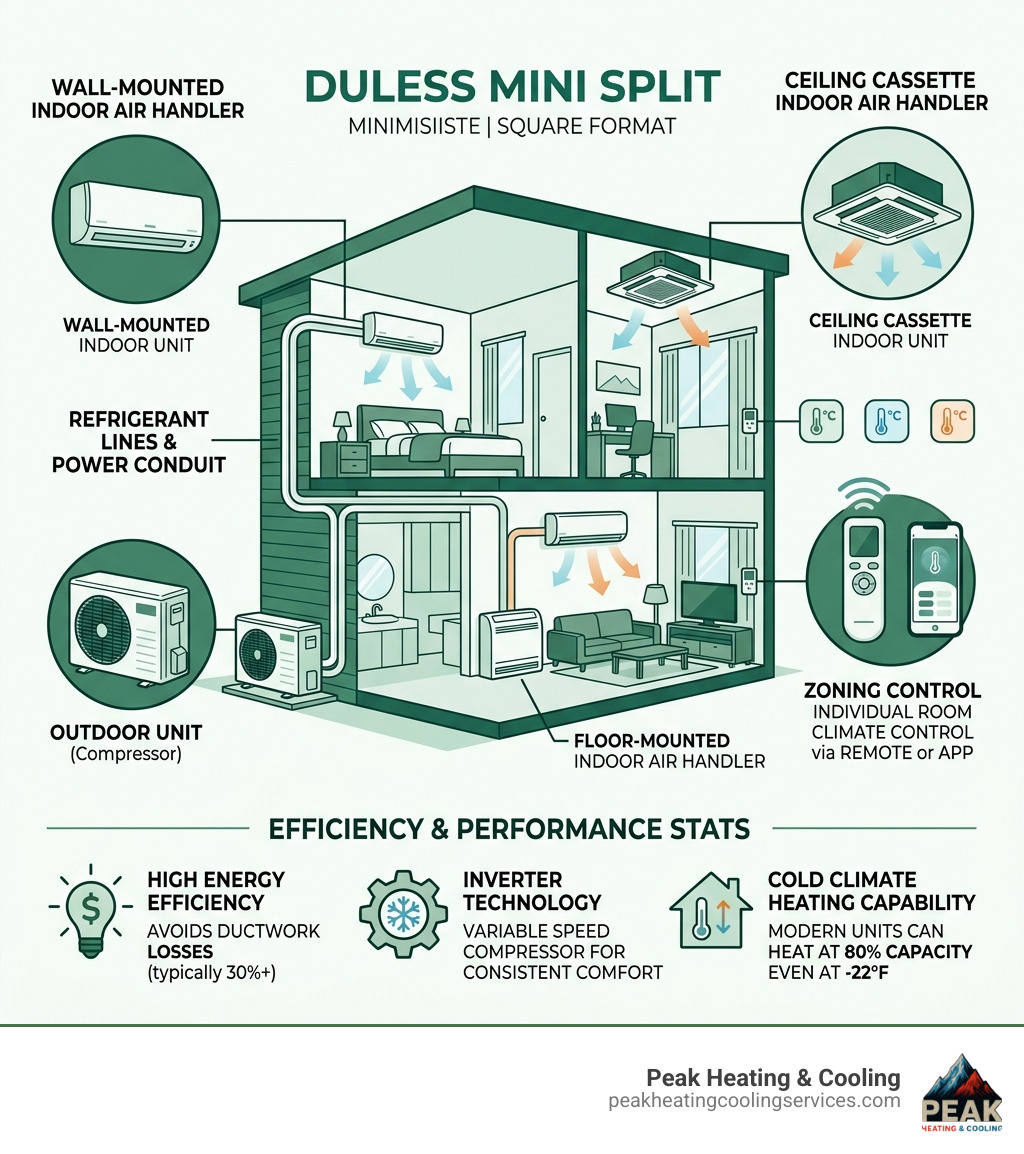
Ductless mini split HVAC is a heating and cooling system that delivers targeted comfort to individual rooms without any ductwork. It has two main parts: an outdoor compressor unit and one or more indoor air handlers, connected by a small conduit through a three-inch hole in the wall.
Here’s a quick snapshot of what you need to know:
| Feature | Details |
|---|---|
| How it works | Transfers heat in or out of your home via refrigerant lines |
| Heating & cooling | Yes — most models do both |
| Number of zones | 1 to 8 indoor units per outdoor unit |
| Energy savings | Avoids the 30%+ energy loss typical of ducted systems |
| Cold climate use | Modern units can heat at 80% capacity even at -22°F |
| Typical lifespan | 10 to 20 years with proper maintenance |
| Best for | Older homes, additions, garages, home offices, uneven heating/cooling |
If you’re a Chicagoland homeowner dealing with uneven temperatures, high energy bills, or a room addition that your existing system can’t reach — a mini split might be exactly what you need.
And if you’re already familiar with the basics and just want expert help, Peak Heating & Cooling serves Glenview, Northbrook, Skokie, and the surrounding North Shore area with licensed, insured installation and same-day service.
This guide covers everything else: how these systems work, how to size them correctly, what installation really involves, and how to keep one running for decades.
Understanding the Ductless Mini Split HVAC System
To understand why so many homeowners in Glenview and Northbrook are switching to ductless technology, we first have to look at how these systems differ from the massive furnaces and central AC units we grew up with. According to the Department of Energy, a ductless mini split HVAC system is a highly versatile solution for residential, commercial, and even institutional buildings.
Unlike central air, which relies on a network of bulky ducts to push air throughout the house, a mini split delivers conditioned air directly into the room where the unit is installed. The system consists of two primary components: an outdoor compressor or condenser and an indoor air-handling unit. These are linked by a “conduit,” which is essentially a bundle containing the power cable, refrigerant tubing, suction line, and a condensate drain.

Core Components of a Ductless Mini Split HVAC
The magic of the mini split happens within a few high-tech parts. Inside the indoor unit, you’ll find evaporator coils and a fan. The outdoor unit houses the compressor and expansion valve. As refrigerant cycles through the lines, it absorbs or releases heat, depending on whether you are cooling or heating your home. Because there are no ducts to leak or collect dust, the air you breathe is often cleaner and the temperature more consistent.
Single-Zone vs. Multi-Zone Ductless Mini Split HVAC
One of the biggest draws for our customers in Skokie and Wilmette is zoning flexibility.
- Single-Zone: Perfect for a single room addition, a garage workshop, or a sunroom that always feels like an oven in July. One outdoor unit connects to one indoor unit.
- Multi-Zone: This is where things get exciting. A single outdoor unit can support up to eight indoor units. This allows you to have independent thermostats for every room. If you want the master bedroom at a crisp 68 degrees but the guest room at a cozy 72, a multi-zone system makes it happen without a “thermostat war.” This is an ideal setup for multifamily housing or large historic homes where installing new ductwork is physically impossible or prohibitively expensive.
How Ductless Technology Delivers Targeted Comfort
If you’ve ever wondered how a small box on the wall can keep a whole room comfortable during a Chicago heatwave, the answer lies in heat pump technology and inverter compressors. While traditional systems are either “all on” or “all off,” modern mini splits use variable-speed technology. Think of it like cruise control for your home’s temperature; the system adjusts its speed to maintain a steady climate rather than constantly cycling on and off.
Cooling and Heating Mechanics
In the summer, the indoor unit absorbs heat from your room and transfers it outside. In the winter, the process reverses. A reversing valve allows the system to pull heat from the outdoor air—even when it’s cold—and move it inside. This heat transfer process is significantly more efficient than generating heat through electric resistance or burning fossil fuels.
Cold Climate Performance
We know what you’re thinking: “Can a heat pump really handle a January night in Des Plaines?” Years ago, the answer might have been no. However, modern ENERGY STAR certified units are built for our climate. Some advanced models can continue heating at 80% capacity even when outdoor temperatures drop to -22°F. By using advanced refrigerants and high-performance compressors, these systems provide reliable warmth throughout the harshest Illinois winters.
Advantages of Going Ductless in Chicagoland
For homeowners in the North Shore and Northwest suburbs, the benefits of a ductless mini split HVAC go far beyond just “getting rid of ducts.”
- Energy Savings: Traditional central air systems can lose more than 30% of their energy consumption through ductwork leaks and poor insulation. Ductless systems eliminate this loss entirely.
- Indoor Air Quality: Without ducts to collect pollen, dust, and pet dander, and with multi-stage filtration built into every indoor head, the air quality in your home improves significantly.
- Quiet Operation: Many indoor units operate at sound levels as low as 19 dB—that’s quieter than a whisper or rustling leaves.
Energy Efficiency and Rebates
When shopping for a system, look for the SEER2 (Seasonal Energy Efficiency Ratio) and HSPF2 (Heating Seasonal Performance Factor) ratings. High-efficiency models, like those we recommend from Lennox and Ducane, can reach over 30 SEER2. Not only do these save you money on monthly bills, but they may also qualify for federal tax credits of up to $2,000 and various local utility incentives.
Ideal Use Cases for Local Homeowners
We frequently install these systems in:
- Historic Homes: Places in Winnetka or Glencoe where there is no room for ductwork.
- Sunrooms and Garages: Spaces that weren’t originally tied into the central HVAC.
- Home Offices: Where you need extra cooling for computers and electronics.
- Uneven Heating Solutions: For that one bedroom that is always five degrees colder than the rest of the house.
For more information on how these fit into a broader home comfort plan, check out our page on HVAC installation.
Sizing and Efficiency Ratings for Your Home
Getting the right size is critical. If a unit is too small, it won’t keep up with a humid July afternoon. If it’s too large, it will “short cycle,” turning on and off too quickly, which ruins efficiency and fails to remove humidity from the air.
Determining the Right BTU Capacity
We use a Manual J calculation to determine the exact BTU (British Thermal Unit) capacity your space needs. This takes into account square footage, ceiling height, insulation quality, and even the direction your windows face. Generally:
- 6,000 to 9,000 BTU: Good for small bedrooms or home offices (approx. 250–400 sq. ft.).
- 12,000 to 18,000 BTU: Ideal for living rooms or large master suites (approx. 500–1,000 sq. ft.).
- 24,000 to 36,000 BTU: Necessary for large open-concept spaces or basements (up to 1,500 sq. ft.).
Understanding SEER2 and HSPF2
These ratings tell you how much comfort you get for every dollar spent on electricity. A higher SEER2 means better cooling efficiency, while a higher HSPF2 indicates better heating performance. Investing in a premium unit might seem like more upfront, but the long-term energy savings often make it the smarter financial choice. For tips on keeping these ratings high through the years, read our guide on HVAC maintenance.
Professional Installation and Maintenance Roadmap
While some “DIY” kits exist, installing a ductless mini split HVAC involves handling refrigerants, high-voltage electricity, and precise wall penetrations. In our experience serving Glenview, Northbrook, and Skokie, professional installation is the only way to ensure your warranty remains valid and your system runs safely.
Why Professional Installation Matters
Our EPA-certified technicians ensure that the refrigerant lines are vacuumed and leak-tested, and that the condensate drainage is sloped correctly to prevent water damage. We also handle the electrical work and ensure everything meets local HOA codes and building requirements. For a deeper look at the pitfalls of doing it yourself, see The risks of DIY installation. As a licensed and insured HVAC contractor, we take the guesswork out of the process.
Routine Maintenance for Longevity
A well-maintained mini split can last 20 years. Your primary job as a homeowner is simple: clean the filters once a month. Dusty filters restrict airflow and force the motor to work harder. Beyond that, we recommend an annual professional tune-up to inspect the coils and check refrigerant levels. You can find a full checklist in our HVAC maintenance roadmap.
Frequently Asked Questions
How long do ductless mini split systems last?
With professional installation and regular filter cleanings, you can expect a high-quality system to last between 10 and 20 years. Using premium brands like Lennox or Ducane further ensures a durable investment.
Do mini splits pull air from the outside?
No. This is a common myth. Mini splits recycle and filter the air already inside your home. They only move heat between the inside and outside using refrigerant. This means you aren’t bringing in outdoor humidity, allergens, or pollution.
Can a mini split heat an entire home in Illinois?
Yes, absolutely. By using a multi-zone configuration with cold-climate rated outdoor units, you can heat an entire home. Many of our customers use them as supplemental heating for “cold spots,” but they are fully capable of whole-home operation in many modern or retrofitted Chicagoland houses.
Conclusion
The era of bulky ductwork and noisy window units is fading. Ductless mini split HVAC technology offers a personalized, energy-efficient future for your home comfort. Whether you are looking to reclaim your garage, finish a basement, or finally get some sleep in a cool bedroom, we are here to help.
At Peak Heating & Cooling, we pride ourselves on being a trusted local partner for families in Glenview, Northbrook, and throughout the Chicagoland area. We offer same-day repairs, 24/7 emergency service, and 0% financing options for qualified customers to make your transition to ductless as smooth as possible.
Ready to experience zoned comfort? Schedule your HVAC installation in Glenview IL today and let us help you find the perfect system for your home.